Walstad Vs Father Fish: Which Builds A Better Planted Aquarium?
The Walstad Method and the Father Fish Method are two of the most popular approaches to setting up planted aquariums using capped dirt substrates.
While they share a lot of surface-level similarities — like using soil and live plants to build a natural ecosystem — some important key differences set them apart.
It’s easy to see why these two methods often get confused.
Both rely on dirt capped with sand or gravel and promote a more natural, self-sustaining aquarium.
But blending techniques from both approaches in a single tank can lead to problems if you’re not careful, due to the subtle but important differences in how each system functions.
In this post, I’ll break down those differences in detail.
Substrate Composition: A Fundamental Difference
One of the biggest differences between the Walstad Method and the Father Fish Method lies in how each approach handles substrate composition.
The Walstad Method
In the Walstad Method, the substrate setup is simple and minimalistic.
You use a basic layer of soil as the foundation, capped with either sand or gravel, and that’s it.
Diana Walstad is very specific about this in her book, recommending plain garden or potting soil with no added fertilizers, enhancements, or chemical treatments1.
The idea is to let the ecosystem take care of itself over time, with fish food, fish waste, and plant matter fueling a self-sustaining nutrient cycle.
Walstad also explains that while the soil may only supply carbon for around 11 months, the system continues to function through bacterial decomposition and the regular input of fish food.
The Father Fish Method
The Father Fish Method takes a more additive-heavy approach.
Instead of using soil, the base layer is enriched with a mix of supplements — a combination Father Fish outlines in detail in his videos and also sells pre-made on his website2.
These additives are designed to extend the soil’s nutrient availability for several years, with Father Fish claiming they can last up to five years before needing to be refreshed.
He views this as a solution to a problem he believes exists in Walstad tanks — that they may begin to “fail” after a year as the soil’s nutrients run out.
Feeding And Nutrient Input
But there’s a key difference in how each method keeps the nutrient cycle going.
Diana Walstad feeds her fish generously and intentionally adds a little extra to nourish the plants via waste and decomposition.
This steady input of organic matter continuously replenishes nutrients, making extra soil amendments unnecessary in her system.
Father Fish, by contrast, relies on a “living food web” and feeds much more lightly.
In one of his videos, he claims that over five years, organic material naturally breaks down into detritus, creating a sustainable nutrient source, just on a slower timeline3.
This slower nutrient input makes the enriched soil much more important in Father Fish tanks.
In contrast, the Walstad Method’s heavier feeding strategy accelerates the recycling of nutrients through detritus and plant decay.
A Word of Caution: Don’t Mix The Two
It might be tempting to blend these approaches — for example, using enriched Father Fish soil while following Walstad-style heavy feeding.
But this can be risky.
Combining both high-nutrient soil and generous feeding can overload your system with nutrients, leading to algae outbreaks, imbalances, or even water quality issues.
Each method is designed to work as a self-contained ecosystem. Mixing them without a clear plan can do more harm than good.
Substrate Depth And Cap Material: How Much Matters
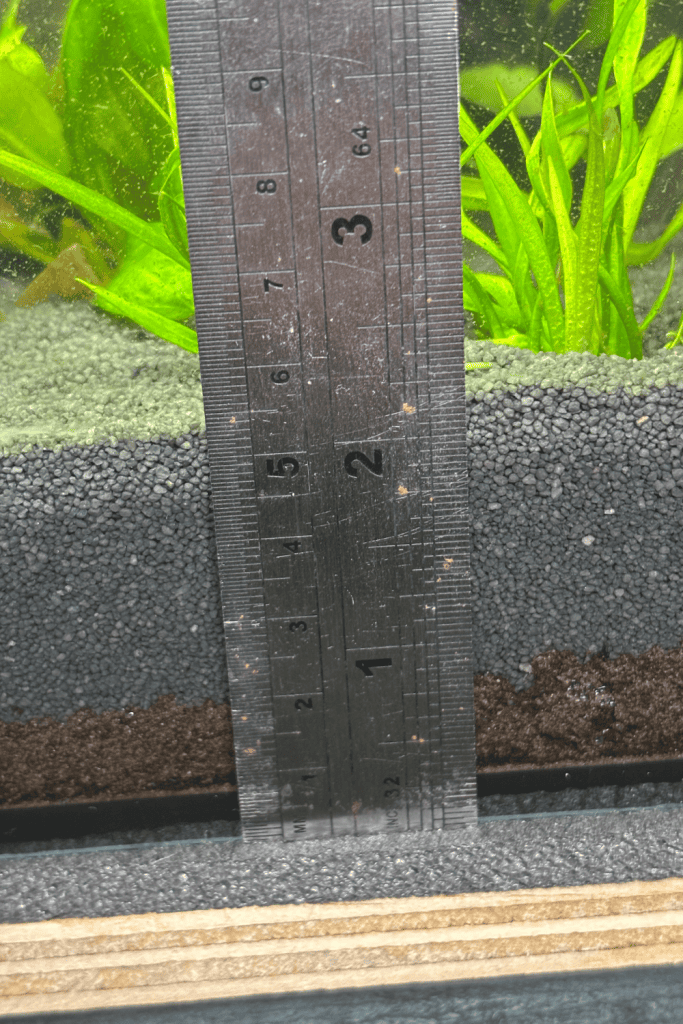
Substrate depth is another key difference between the Walstad and Father Fish methods, and it has a major impact on how the substrate behaves over time, especially when it comes to oxygen flow and gas buildup.
Walstad Method: Shallow And Precise
The Walstad Method recommends a straightforward approach to substrate depth4:
- Soil layer: ~1 inch
- Cap layer: No more than 1 inch of small gravel (2–3 mm grain size)
Diana Walstad also mentions that sand can be used as a cap instead of gravel, but she advises limiting the sand depth to no more than ¾ inch.
The reason? Sand compacts more tightly than gravel and can suffocate the soil below if used too thickly.
This can lead to low-oxygen conditions, increasing the risk of harmful hydrogen sulfide buildup5, especially in tanks that receive a lot of fish food.
In my experience, a cap of 2 mm gravel that’s 1 inch or less deep allows for just enough water flow and oxygen penetration to prevent these issues in a Walstad tank.
Father Fish Method: Thicker And Less Specific
Father Fish suggests using a 1-inch layer of dirt capped with 2 inches of sand6.
However, unlike Walstad, he doesn’t verbally specify a sand grain size — and that’s important.
Sand comes in many forms, from very fine to very coarse, and grain size dramatically affects how tightly the particles pack together.
Finer sand packs more densely, which can block oxygen movement and promote anaerobic (low-oxygen) zones.
That’s not necessarily a bad thing — more on that in a moment — but it’s something aquarists should be aware of.
Father Fish often emphasizes the importance of using sand, but in his book, he recommends a grain size of 1 to 3 mm7, mirroring the advice of Diana Walstad.
However, despite his strong advocacy for sand, it’s worth noting that grains in the 2 to 4 mm range are very fine gravel, not sand8.
Debunking Brownian Motion Claims
Father Fish justifies his use of a 2-inch sand cap by referencing Brownian motion, claiming it causes soil particles to move upward into the sand layer9.
He claims that a thicker sand layer prevents this from happening.
However, this isn’t scientifically accurate.
Brownian motion refers to the random movement of particles suspended in a liquid or gas10, not solid particles trapped under a sand cap.
The soil in these tanks isn’t suspended in water — it’s physically blocked by a dense cap — so this explanation doesn’t hold up.
In reality, I believe trapped gas escaping from the soil is what causes soil particles to rise into the sand layer.
Oxygen Levels And Substrate Conditions
One concern with the Father Fish method is that the combination of fine sand and a deep cap could limit oxygen penetration into the soil.
This can result in:
- Hypoxic (less than 2-3 milligrams of oxygen per liter of water)11
- Anoxic (molecular or free oxygen (O2) is absent, though bound oxygen may be present)12
- Anaerobic (no free and bound oxygen)13
These zones can produce gas that disrupts the substrate, pushing soil up into the sand layer, releasing methane14, which can cause the aquarium to develop an unpleasant odor.
In Walstad tanks, these issues are far less common because the shallower sand cap allows gases to escape more easily, preventing substrate disruption, enforcing aerobic conditions (with molecular oxygen15) that restricts methane production, preventing bad smells16.
The Potential Benefits Of Low-Oxygen Zones

Interestingly, the low-oxygen zones in Father Fish-style tanks may have an upside.
They can foster specialized beneficial bacteria that play a role in the nitrogen cycle:
- Denitrifying Bacteria: These can convert nitrate into nitrogen gas171819.
- Anaerobic Ammonium-Oxidizing (Anammox) bacteria: These bacteria can convert ammonium and nitrite directly into nitrogen gas, skipping the nitrate step entirely2021.
While there’s debate about whether these bacteria commonly thrive in home aquariums, there is research supporting the possibility — and I’ve observed reduced nitrate levels in lava rock-heavy tanks without any plants, which suggests low-oxygen zones can and do form under the right conditions.
The problem with having organic matter—like the humic substances found in soil—trapped in deep substrates is that it can lead to the development of other low-oxygen bacteria.
These bacteria break down the organic material and produce methane gas, which can cause the aquarium to smell22.
Personally, I prefer to try and create low-oxygen zones within lava rock, where there’s no organic matter to fuel this kind of bacterial activity.
This helps encourage beneficial bacteria while reducing the risk of unpleasant odors.
Plant Selection And Nutrient Management

Another major difference between the Walstad and Father Fish methods lies in their approach to plant selection, both in variety and function.
The Walstad Method: Fast-Growing Plants For Filtration

Diana Walstad places a strong emphasis on plants as natural water purifiers23.
In her book, she dedicates full chapters to explaining how aquatic plants absorb nutrients, improve water quality, and play a critical role in maintaining balance in the aquarium.
If you’re new to the hobby, her advice is to start with a wide range of healthy plants and observe what thrives in your particular setup.
Fast-growing species are especially important, as they help remove excess nutrients quickly and efficiently, particularly ammonium24, which helps reduce toxic nitrogen compounds like ammonia and nitrite.
Some of the species she specifically recommends include:
Both are excellent choices for natural filtration, and I recommend them as well, but I also have a dedicated article on the best plants for Walstad Method tanks.
Floating plants are another key part of the Walstad Method.
Their fast growth and ability to absorb nutrients directly from the water column2526 make them powerful tools for keeping the ecosystem in balance.
The Father Fish Method: Less Emphasis On Plant Function
In contrast, the Father Fish Method doesn’t place as much emphasis on fast-growing or nutrient-hungry plants.
In one video, Father Fish recommends using one plant per gallon of water27, but doesn’t suggest any specific species in that context.
He also has a tank setup video, where he lists several plants he commonly uses28:
- Moss
- Bucephalandra
- Aponogeton
- Bolbitis
- Rotala indica
- Alternanthera Reineckii (referred to as “Bucephalandra Scarlet Temple” in parts of the USA)
Out of this list, Rotala indica is the only one I’d consider a strong natural water purifier.
Most of the others are slow-growing or ornamental species, which don’t contribute significantly to nutrient uptake.
While he does recommend stem plants in another video, the suggestion seems linked more to a promotion on his website29 than a core principle of the method.
Additionally, I haven’t seen him recommend floating plants, which are central to the Walstad approach.
Confusion On Plant Recommendations

When I originally published the video version of this article on YouTube over two months ago, Father Fish left a comment claiming he “never recommended buce.”
In response, I linked directly to his video on setting up a Father Fish method tank and time-stamped to the exact moment where he recommends Bucephalandra (“Buce”).
As of the time of writing this article—76 days later—he has yet to respond, further adding to the confusion surrounding his method and plant recommendations.
Why The Difference Matters
This difference in plant strategy may come down to the core philosophy of each method.
- The Walstad Method uses fish food, plant decay, and decomposition to maintain a nutrient-rich environment, which is balanced by fast-growing plants.
- The Father Fish Method, by contrast, uses fewer nutrients and relies more on specialist bacteria in low-oxygen substrate zones to manage ammonia and nitrite.
While this bacterial approach may control nitrogen compounds effectively, it leaves the Father Fish system more vulnerable to TDS (total dissolved solids) buildup over time, especially if you’re only topping off evaporated water without doing regular partial water changes.
Managing TDS Without Frequent Water Changes
There’s a common myth in the aquarium hobby that TDS will always increase unless you do water changes.
But that’s not entirely true.
Research in wastewater treatment and phytoremediation shows that the right plants can absorb a surprising amount of the dissolved ions that contribute to TDS.3031323334353637
In fact, the fast-growing plants recommended in the Walstad Method — such as:
— are incredibly effective at managing both nitrogen compounds and TDS.
These plants don’t just remove ammonia and nitrite — they also absorb minerals and excess nutrients that would otherwise accumulate over time, keeping your tank more stable and reducing long-term risks.
The table below goes over the removal rate of various TDS ions by Lemna minor (duckweed) as covered in my article on why duckweed is the best plant for filterless, zero water change tanks.
| Heavy Metal | Absorption % |
|---|---|
| Mercury | 99.53 |
| Chromium | 94 |
| Nickel | 86.64 |
| Lead | 82.89 |
| Copper | 81.41 |
| Manganese | 77 |
| Iron | 77 |
| Cadmium | 76.73 |
| Zinc | 73.51 |
| Arsenic | 70 |
In contrast, the slower-growing plants Father Fish seems to recommend in his videos39 may not keep up with that kind of nutrient management, especially if you’re not doing water changes.
This can quickly become an issue for sensitive species like shrimp, which may be affected by rising levels of copper or other trace metals present in tap water, even if fish seem fine.
A Simple Fix For Father Fish Tanks
If you’re using the Father Fish Method and want to avoid TDS-related issues, there’s a simple solution: add more fast-growing plants.
- Include stem plants and stolon-spreading species that consume nutrients quickly.
- Add floating plants like duckweed or water lettuce, which work especially well for nutrient control.
Even small additions like these can make a big difference in helping stabilize your tank over the long term, or you can do regular partial water changes, and here’s my article going over aquarium water changes in detail.
Monitor Your Water Parameters

Regardless of which method you’re using, one thing remains true: check your water parameters regularly, at least with a standard test kit that checks nitrogen compound levels.
Even if your setup is low-maintenance or “self-sustaining,” your fish and shrimp depend on stable conditions.
If the parameters drift too far out of range, don’t hesitate to do a water change. It’s better to prevent problems early than to deal with crashes later.
Cycling A Dirted Tank: Why It Matters And How To Do It Safely

One of the most important — and often misunderstood — steps in setting up a dirted aquarium is the initial cycle.
This phase establishes the biological foundation of your tank, allowing beneficial microorganisms and plants to process harmful nitrogen compounds and create a safe environment for your fish or shrimp.
Why Cycling Is Crucial
When organic matter like fish waste, uneaten food, or decaying plants breaks down, it releases ammonia, a highly toxic compound.
The cycling process allows bacteria and archaea40 to:
- Convert ammonia into nitrite (also toxic),
- Then convert nitrite into nitrate, which is much safer and also serves as plant food.
There’s also ammonium41, which is a less toxic form of ammonia that forms when excess hydrogen ions bind with it — another key part of the cycle.
So, to summarize:
- Ammonia & nitrite = toxic
- Ammonium & nitrate = less toxic (often beneficial in planted tanks)
Walstad’s Take On Cycling
In one of her articles about small planted shrimp tanks, Diana Walstad mentions that she sometimes adds shrimp immediately, but generally recommends waiting42.
That’s because new tanks often go through ammonia or nitrite spikes early on, and shrimp can be harmed by even a small drop in water quality.
In these cases, she suggests frequent water changes during the early weeks to manage toxicity.
Allowing the tank to sit for a month or two gives plants time to establish themselves and allows beneficial microorganisms to develop by feeding on the ammonia released from the soil.
This process helps create a stable, safe environment in the tank before introducing fish and shrimp.
Father Fish’s Approach: Fish-In Cycling
Father Fish, on the other hand, appears to favor a fish-in cycle approach.
In one of his videos, he even claims that tanks can’t cycle without fish43.
That’s not accurate.
Modern fishless cycling methods, like the “dark start” method, prove otherwise.
These approaches use an ammonia source (like ammonia solutions or decaying organics) to simulate a bioload and establish bacteria colonies, without putting live animals at risk.
I’ve personally used the dark start method many times with great success, especially for my aquasoil setups.
What’s surprising is that in Father Fish’s nearly 10-minute video on cycling dirted tanks, he doesn’t mention the difference between water-soluble and insoluble ammonia44, even though this is a major consideration when using soil as your substrate.
Many soil products contain a significant amount of water-soluble ammonia, which leaches into the aquarium’s water column.
This provides a natural ammonia source to cycle the tank safely, without putting your fish at risk.
Always Monitor Your Water Parameters
No matter which method you use, the best way to avoid problems is to monitor your water quality during the initial cycle.
- A liquid test kit is ideal.
- If that’s not in your budget, ammonia test strips are better than nothing.
Keep a close eye on ammonia levels.
Anything above 0.5 ppm should be addressed with partial water changes to protect your plants.
High ammonia doesn’t just harm animals — it can also damage or “melt” delicate plant species, especially in vitro-grown plants.
In fact, Diana Walstad has mentioned doing 90% water changes early on when setting up one of her planted bowls, just to manage initial ammonia spikes45.
When Is It Safe To Add Fish?
Once your ammonia and nitrite levels are consistently reading 0 ppm, your tank is considered cycled.
At that point, you can safely begin adding small numbers of fish or shrimp as the plants and microorganisms are becoming more established.
Taking the time to cycle your dirted tank properly will save you from future headaches and create a healthier, more stable environment for everything living in your tank.
How The Walstad And Father Fish Methods Sustain The Nitrogen Cycle

Once a tank is fully cycled, the real test begins: can the system hold that cycle and maintain long-term water stability without frequent interventions?
Both the Walstad Method and the Father Fish Method are often associated with filterless or low-tech aquariums, but how each method sustains the nitrogen cycle varies in key ways.
Do These Methods Require Filters?
Let’s clear something up right away — neither method strictly requires a filter, but both Diana Walstad and Father Fish have confirmed that they do use filters in some of their setups.
In many cases, the filter serves more as backup biological support than as the primary driver of water quality.
Walstad Method: Plants Lead The Cycle
The Walstad Method clearly leans on fast-growing plants to purify the water.
This isn’t just theory — it’s strongly backed by research in phytoremediation and wastewater treatment, where fast-growing aquatic plants have been proven to:
Here’s how the nitrogen cycle typically unfolds in a Walstad-style setup:
- Ammonia enters the tank through fish waste, uneaten food, and decaying organic matter.
- Hydrogen ions bind to some of this ammonia, forming ammonium, a less toxic, plant-available form of nitrogen.
- Fast-growing plants absorb ammonium quickly, reducing the need for nitrite-oxidizing bacteria to intervene.
- Smaller bacterial colonies handle any remaining ammonia, converting it to nitrite and then nitrate.
- As ammonium becomes scarce, plants shift to using nitrate, further helping to prevent buildup.
🧪 In my experience with Walstad setups, I’ve never seen nitrate levels drop to absolute zero — but they remain consistently low.
This system works because the plants passively regulate ammonia levels, which reduces the demand on nitrifying bacteria and supports long-term biological stability.
Father Fish Method: Bacteria Do the Heavy Lifting
With the Father Fish Method, the path to nitrogen stability is less plant-focused.
Although bacteria are mentioned as part of the system, a lot of the plants i’ve seen him recommend (like Anubias, mosses, bucephalandra, and Bolbitis) are slow growers and not ideal for rapid nutrient uptake.
Based on my research — and after reviewing many of his videos and product listings — there’s a lack of specific plant guidance with the Father Fish method.
I even found images of Java Fern50 and Windalov Fern51 planted with their rhizomes buried, which can harm the plant, suggesting a gap in fundamental plant care knowledge.
So, if slow-growing plants aren’t driving the nitrogen cycle, what is?
Specialist Bacteria
I believe the deep, fine-grain sand cap commonly used in Father Fish-style tanks creates low-oxygen zones, and these zones may support specialist bacteria that aren’t often discussed in mainstream aquarium literature.
As covered earlier, there are Two groups of bacteria are especially relevant here:
- Denitrifying Bacteria
- Anaerobic Ammonium-Oxidizing (Anammox) Bacteria
In theory, this is how the cycle could work in a Father Fish setup:
- Ammonia enters the system.
- Hydrogen ions bind to some of the ammonia, forming ammonium.
- Slow-growing plants absorb a portion of this ammonium.
- Standard nitrifying bacteria convert the rest of the ammonia into nitrite.
- In the right conditions, Anammox bacteria use both ammonium and nitrite to produce nitrogen gas, which safely escapes the system.
- Denitrifying bacteria may also reduce leftover nitrate into nitrogen gas, completing the cycle.
🌬️ This could explain why some Father Fish tanks show low nitrate levels despite lacking fast-growing plants.
The Core Difference
- Walstad Method: The nitrogen cycle is primarily held by fast-growing plants, supported by small bacterial colonies.
- Father Fish Method: The cycle may rely more on specialist low-oxygen bacteria in the substrate, with minimal plant intervention.
Why This Matters
Understanding how each system holds the nitrogen cycle is crucial for long-term success, especially if you’re attempting to run a filterless tank.
The underlying biology is different, and knowing what’s doing the work in your tank helps you troubleshoot and maintain stability more effectively.
Fertilization: Feeding The System Without Overloading It

Fertilization is another area where the Walstad Method and Father Fish Method diverge significantly, not just in how nutrients are delivered, but in how each system is designed to handle nutrient cycling over the long term.
Walstad Method: Fish Food + Decomposition = Sustainable Nutrients
Diana Walstad is very clear in her book: fish food is the primary fertilizer in her system.
There’s even an entire chapter dedicated to nutrient sources, including a section on how bacterial decomposition releases minerals into the water that plants can use.
One quote from her sums it up well:
“I always feed my fish well, plus add a little extra for the plants.”
That single sentence highlights the core idea behind fertilization in the Walstad Method — it’s not about adding commercial fertilizers or soil boosters, but about feeding the tank well and letting natural decomposition do the rest.
I like to think of Walstad-style fertilization in two stages:
- Short-term: Nutrients come from the soil, including essential macros, micros, and humic substances that can even release small amounts of natural CO₂ as they are broken down525354.
- Long-term: As the soil depletes over time (especially nutrients like carbon), the system shifts to relying on detritus — fish waste, leftover food, and decaying plant matter — as a continuous source of nutrients.
This system becomes more efficient over time, with waste eating bacteria breaking down waste and releasing nutrients back into the water column for plants to absorb.
Walstad does mention that liquid fertilizers like API Leaf Zone can be helpful, particularly to correct potassium deficiencies, which can be common in planted tanks.
However, in my experience, they’re not usually necessary unless you’re growing more demanding plant species.
Father Fish Method: Enriched Soil, Light Feeding
The Father Fish Method takes the opposite approach.
Rather than feeding heavily, he recommends feeding very lightly55 and depending on a pre-enriched soil mix to provide long-term nutrients.
This enriched substrate is loaded with various additives designed to last up to five years — the length of time Father Fish claims it takes for the soil to fully “recycle.”
That’s a bold claim, and while it may work in his specific system, my own experience with Walstad-style tanks suggests it’s unnecessary.
I’ve had tanks running for over a year without enriched soil, and the plants are still thriving thanks to the detritus-based nutrient cycling that kicks in as the system matures.
Misunderstanding Liquid Fertilizers?
In one of Father Fish’s videos, a guest holds up a bottle of API Leaf Zone, pointing out that it contains only iron and potassium.
Father Fish responds by calling it “excess iron and excess potassium” and warns that using it will raise your water hardness until your tank becomes like the Dead Sea56.
Let’s clear up a few misconceptions here:
- Iron and potassium do not raise water hardness.
General hardness (GH) is affected by calcium and magnesium57, not iron or potassium. - Aquatic plants can absorb nutrients from the water column58.
There’s extensive documentation supporting this — in fact, many species prefer it. - Potassium is one of the most commonly deficient nutrients in aquariums, and bioavailable iron is also often limited59.
- And finally, the Dead Sea is lifeless because of its extreme salinity, not its hardness. It’s a completely different issue that has no relevance to a home aquarium.
When the guest suggests doing water changes to manage potential excesses, Father Fish responds that “water changes won’t remove everything.”
But again, this misses a key point: plants will consume those nutrients, especially fast-growing varieties.
And once you stop dosing, the levels naturally decline over time.
Using Dead Fish As Fertilizer?
In another video, Father Fish references the old farming practice of burying dead fish to fertilize corn60, and suggests doing the same in aquariums.
While that may work for terrestrial plants, it doesn’t translate well to aquatic environments:
- Land plants rely almost entirely on root uptake because they can’t access nutrients through the air.
- Aquatic plants, can absorb nutrients through their leaves and stems — they don’t rely solely on their roots.
Personally, in my shrimp colonies, I let naturally deceased shrimp decompose in the tank.
As long as I’m confident the cause isn’t disease, the shrimp quickly break down and their nutrients are recycled by other tank inhabitants and bacteria.
However, I wouldn’t leave larger fish in the tank — anything bigger than a neon tetra or harlequin rasbora poses too much risk for an ammonia spike.
Father Fish does mention this burial practice in the description of one of his videos, specifically for tanks with a 2-inch sand cap. But here’s the problem:
- Disturbing the substrate can cloud the tank and lead to a messy rescape.
- More importantly, it may disrupt low-oxygen zones, which are likely supporting specialized bacteria that play a key role in maintaining stability in Father Fish-style tanks.
If you disturb those zones — even briefly — it could compromise the bacterial colonies that help sustain the nitrogen cycle.
Don’t Mix Fertilization Strategies
This is worth repeating: do not combine the two fertilization strategies.
If you use Father Fish’s heavily enriched soil and then follow the Walstad approach of feeding generously and relying on detritus, you risk overloading the system with nutrients.
This could lead to algae blooms, water quality issues, or imbalances that are hard to fix.
Each method is designed to function as a self-contained ecosystem, and mixing them — especially when it comes to fertilization — may do more harm than good.
Feeding Strategies: Fueling The Ecosystem

Feeding is one of the biggest functional differences between the Walstad Method and the Father Fish Method — and it’s not just about how much food goes into the tank.
It’s also about what that food supports: plants, bacteria, or a living food web.
Walstad Method: Heavier Feeding To Power The System
In the Walstad Method, feeding isn’t just about keeping your fish full — it’s also a core part of the fertilization cycle.
Moderate to heavy feeding produces:
- Waste from fish and shrimp
- Leftover food
- Organic detritus
All of these become nutrient sources for plants via bacterial decomposition.
This strategy fuels the long-term health of the system and maintains the nutrient availability that helps support plant growth — even as the soil substrate begins to deplete over time.
However, the quality of fish food plays a major role in how well this works.
Low-quality foods can cause imbalances in the system by providing inadequate nutrition or introducing excess fillers that don’t break down cleanly.
My Recommendations For High-Quality Fish Food
Look for products that list insect or fish meal as the main ingredient.
These are nutrient-dense and contribute much more value to your ecosystem.
Here are a few trusted options:
- Fluval Bug Bites:
Primary ingredients: Black soldier fly larvae and salmon meal
Great for insect-based diets and efficient waste output. - Hikari Micro Pellets:
Primary ingredients: Fish meal and krill meal
Ideal for small tropical fish and shrimp. - Hikari Mini Algae Wafers:
Designed for bottom dwellers and algae grazers; fish meal is the first ingredient.
Be cautious with vague terms like “fish derivatives” — often used in brands like Aquarian61 — as this could include lower-quality fish parts62 rather than nutrient-dense fish meal.
✅ Tip: For nano fish keepers, alternating between Fluval Bug Bites and Hikari Micro Pellets is an easy and effective feeding plan that offers excellent nutritional variety.
Father Fish Method: Light Feeding And Natural Food Webs
Father Fish takes a very different approach.
Instead of relying on fish food as a nutrient source, his method emphasizes light feeding and encourages fish to forage for naturally occurring microfauna in the tank.
In his system, fish are encouraged to hunt small organisms like:
- Scuds
- Ostracods
- Worms
- Copepods
This mirrors a more natural ecosystem and can be a fascinating dynamic to watch.
I’ve tried something similar in my 29-gallon zebra danio tank, and the fish clearly enjoyed chasing live prey.
However, there are a couple of concerns:
Limited Nutrients For Plants
While microfauna do contribute some waste, they’re not nearly as effective as decomposing fish food and waste when it comes to enriching the water for plants.
Most of the organic matter they consume is converted into energy, not left behind as nutrient-rich detritus.
That’s fine in a dedicated Father Fish-style system, but if you’re combining methods, this lack of nutrient contribution could cause deficiencies and imbalance.
The Risk Of Resurrection Jars
To kickstart this natural food web, Father Fish often recommends using resurrection jars63 — jars filled with mud and mulch collected from local waterways, left to “revive” microfauna before being added to the tank.
This is where I strongly advise caution.
Visual inspection alone isn’t enough to ensure you’re not introducing:
- Harmful parasites
- Pathogens fish haven’t evolved immunity to
- Unknown fungi or bacteria
⚠️ Many of the fish we keep are captive-bred and have reduced genetic diversity. They may lack resistance to environmental pathogens from other ecosystems.
One study64, for example, showed that:
- Wild guppies had a 96% survival rate when exposed to natural parasites
- Captive-bred guppies had only a 58% survival rate under the same conditions
Using a resurrection jar may be a shortcut to seeding biodiversity, but it carries significant biosecurity risks, especially if you keep sensitive species.
My Approach To Food Webs (Safer Alternative)
As I mentioned, I’ve explored food webs myself, but instead of using a resurrection jar, I bought commercially bred aquatic insects from reputable pond suppliers where quality control was in place.
This gave me all the benefits of natural foraging without the risk of introducing unknown diseases or parasites.
On Competitive Exclusion And Parasites

Father Fish has mentioned the concept of competitive exclusion — the idea that beneficial organisms can outcompete harmful ones.
This concept absolutely applies to bacterial colonies, especially in dirted tanks, where fast-replicating beneficial bacteria dominate.
However, extending this principle to parasites or fungi is far more speculative.
Father Fish also claims that “99% of parasites attack other parasites.”65
That’s a bold statement — and so far, no sources have been cited to support it.
I’d love to see the research, but until then, I remain skeptical.
Bottom Line: Feeding Should Match The Method
- In Walstad tanks, food is a fuel source — not just for fish, but for the entire ecosystem.
- In Father Fish tanks, food is minimized to promote self-sustaining microfauna and reduce external nutrient inputs.
Each feeding strategy supports a completely different ecosystem balance, and mixing the two can disrupt the nutrient cycle and harm long-term stability.
Water Temperature: Supporting Plants Vs. Supporting Bacteria

Water temperature may not seem like a major factor when setting up a planted aquarium, but it actually plays a key role in how the Walstad and Father Fish methods function, especially when it comes to what’s doing most of the filtration work in each system.
Walstad Method: Keep It Warm For The Plants
Diana Walstad recommends maintaining a water temperature of at least 72°F (22°C).
The reason is simple: dormancy66, where plant growth slows significantly in cooler water, which reduces the effectiveness of plants as natural filters.
I’ve personally tested a few cold-water Walstad tanks over the winter, and I found it much harder to maintain healthy plant growth without a heater.
Even hardy species struggled to stay vibrant, and the whole ecosystem became less stable.
Father Fish Method: Warmer Water For Bacteria?
In contrast, Father Fish recommends a much warmer temperature of 82°F (28°C).
In one of his videos, he suggests this temperature with a bit of theatrical flair, as if it’s a controversial stance67 — but in reality, 82°F is a common temperature for:
- Betta fish
- Many tropical species
- Tanks seeded with commercial bottled bacteria
In fact, Fritz Aquatics, a well-known manufacturer of beneficial bacteria products, lists 82°F as the midpoint68 in their recommended temperature range for optimal bacterial activity.
Why The Difference?
This temperature discrepancy reflects a deeper distinction between the two methods:
- The Walstad Method relies heavily on fast-growing plants to maintain water quality. Since plants slow down in cooler water, warmer temperatures help them function as intended.
- The Father Fish Method appears to rely more on bacteria and archaea for nitrogen cycling, especially the types that thrive in low-oxygen, warm environments. These microorganisms tend to be more active and effective at higher temperatures.
Bottom Line:
- Walstad tanks benefit from water temperatures above 72°F to ensure strong plant growth and natural filtration.
- Father Fish tanks may favor warmer water (up to 82°F) to optimize bacterial performance and support a self-sustaining microbial ecosystem.
Either way, the temperature you choose should align with your method and your livestock.
Always make sure your plants, fish, and bacteria can thrive at the temperature range you’re targeting.
Lighting: Simplicity Vs. Outdated Standards

Lighting is another area where the Walstad Method and the Father Fish Method differ quite a bit — not just in philosophy, but in how each method has adapted (or not) to modern lighting technology.
Walstad Method: Simple Lighting Is Usually Enough
Diana Walstad famously said,
“Almost any lighting will do.”
And in many cases, she’s absolutely right — especially with the modern LED lights available today.
While plant choice does matter (some species need more intense lighting than others), most low- to medium-light aquatic plants grow perfectly well under budget-friendly, full-spectrum LEDs.
I’ve even seen excellent results from non-aquarium lighting, like regular desk lamps.
Real-World Example
A friend of mine grows:
- Rotala rotundifolia
- Salvinia
- Crypts
- Dwarf sagittaria
—all under a bedside table lamp, and his Walstad-style tank is thriving.
Personally, I use lights like the Seaoura SR616, which are:
- Full-spectrum
- Affordable
- Feature built-in timers
- Available in nano sizes for less than some basic household lamps (at least here in the UK)
They’ve proven to be more than adequate for the types of plants I keep.
One Overlooked Detail From Walstad’s Book
Despite reading Walstad’s book multiple times, I only recently noticed she recommends a 12-hour photoperiod.
The logic? Shorter daylight signals approaching winter, which can alter plant growth behavior.
It’s a detail I’m keen to experiment with in new setups to see if it makes a noticeable difference.
Father Fish Method: High Wattage, Old School Thinking
This is where I strongly diverge from Father Fish’s advice.
In one of his videos, he recommends using 100 watts of lighting per 20 gallons of water69.
That standard might have made sense in the era of T5, T8, or T12 fluorescent tubes, which were much less efficient than today’s LEDs.
But applying that same rule to modern LED lighting is outdated and overkill.
Why It Doesn’t Hold Up Today
- 100-watt LED lights are excessive for planted tanks — you’ll pay more upfront and waste electricity.
- Many of the plants Father Fish recommends are slow growers that don’t require high-intensity light anyway.
- Overpowered lights can lead to algae problems in slower-growing tanks.
If you’re using a modern fixture like the Seaoura SR616, just match the light length to your tank and you’ll have more than enough light for a successful setup.
Bottom Line:
- Walstad-style tanks thrive under simple, budget-friendly lights, especially when stocked with low- to medium-light plants.
- Father Fish’s lighting advice is based on outdated standards and isn’t necessary or efficient with today’s LED technology.
Water Changes: Necessary Or Overrated?

Water changes are one of the most debated topics when it comes to natural aquarium methods like the Walstad Method and the Father Fish Method.
Both approaches aim to minimize water changes, but they arrive at that goal through different means, and with different results.
The Walstad Method: Minimal Water Changes When The Tank Is Balanced
Diana Walstad is clear on this: frequent water changes are not necessary in a well-established, properly stocked tank.
In her experience, she may go three to six months between water changes once the system stabilizes.
However, she also notes that new setups often require more frequent water changes in the first few months.
This is due to ammonia being released from the soil before the plant and microorganism population have matured enough to handle it.
This is the approach I follow myself.
Fast-growing aquatic plants play a big role in managing:
- Nitrogen compounds (ammonia, nitrite, nitrate)
- Total Dissolved Solids (TDS)
There’s plenty of peer-reviewed research confirming their effectiveness at nutrient absorption and water purification.
When I Still Do Water Changes
I’m not against water changes when they’re needed.
In fact, I do them routinely in tanks where nutrient buildup requires it:
- 40-gallon non-Walstad tank:
Gets a 50% water change monthly, not for ammonia or nitrate, but to control phosphate and prevent algae outbreaks. - Betta tank (non-Walstad):
Gets 25% weekly changes because I use a DIY Estimated Index (EI) fertilization routine that increases TDS, requiring regular dilution.
That said, my Walstad tanks rarely need water changes, and that’s because they’re well-stocked, heavily planted, and monitored regularly.
I use multiple test kits and check parameters at least monthly, weekly until recently.
🧪 If your tank is set up and stocked properly, with good plant growth, chances are you’ll need far fewer water changes.
The Father Fish Method: No Water Changes — Really?
Father Fish takes things even further.
In his now-infamous video titled “Stop Changing Your Water”, he argues that water changes aren’t just unnecessary — they might even be harmful7071.
The core of his argument is similar to Walstad’s:
If your water parameters are stable and within safe ranges, don’t change the water.
So far, so good.
But then, he introduces a much more controversial claim72:
Fish can become “accustomed” to the specific chemistry of their tank water, and changing it may cause them to die.
This idea has been widely repeated online, but it doesn’t hold up to scrutiny.
A Real-World Example That Disproves It
One of my Walstad tanks went through an ammonia spike due to overfeeding.
I had to perform a large emergency water change to bring it under control.
That tank hadn’t had a water change in months — just top-offs.
And guess what?
- The cherry shrimp colony is still thriving.
- The two Medaka rice fish in the tank are doing great, almost twelve months later.
If fish truly became “dependent” on specific water chemistry and died from sudden changes, this outcome wouldn’t be possible.
Let’s Talk About Plop-And-Drop
The plop-and-drop method is a widely accepted and commonly used way of introducing fish to a new tank. It involves:
- Temperature-matching the bag,
- Netting the fish,
- And adding them straight to the tank — without drip acclimation.
Despite different water parameters between stores and homes, this method works just fine for the vast majority of hobbyists.
If the “fish get used to your water and can’t handle change” theory were true, plop-and-drop would result in mass die-offs — and that’s simply not the case.
🎓 Jason from Prime Time Aquatics — who holds a Master’s in Biotechnology and Aquaculture Science — has a fantastic video explaining why plop-and-drop is often safer than drip acclimation, even with parameter changes.
Then there’s the global fish trade:
- Fish are moved between breeders, wholesalers, and stores with wildly different water conditions.
- Hobbyists routinely rehome long-term fish between regions with different water chemistry — and again, the vast majority of these fish do just fine.
The Real Takeaway On Water Changes
- Both Walstad and Father Fish agree that water changes aren’t needed in a stable tank with balanced parameters.
- But only the Walstad Method is supported by scientific research, particularly on the role of fast-growing plants in controlling TDS and nitrogen compounds.
Father Fish’s claim about fish “adapting” to water and dying if it changes is, at best, an anecdotal theory.
There’s no named compound, no evidence, and no data — just speculation.
In contrast, the science behind TDS and how plants absorb dissolved nutrients is well-documented.
🌿 In a Walstad tank, plants handle nutrient buildup — meaning TDS doesn’t rise indefinitely, as long as you’re not overfeeding or overdosing.
Bottom Line
If your water parameters are stable, a water change might not be necessary.
But if your tank needs a water change — due to an ammonia spike, a nutrient imbalance, or visible stress on your livestock — do the water change.
Forget the myths.
Just focus on what’s best for your tank.
A Quick Note On The Books Behind Each Method

Both the Walstad and Father Fish methods have books associated with them, but they differ quite a bit in terms of authorship, reception, and availability.
Diana Walstad’s book, The Ecology of the Planted Aquarium, has been widely praised by the aquarium community.
It currently holds an impressive 4.5-star average from over 1,350 reviews on Amazon, a strong indicator of its credibility and value.
Over the years, Walstad has also released multiple updated editions, incorporating new scientific research and refining the method as new discoveries are made, always with an emphasis on improving outcomes for the fish and plants.
The situation around the Father Fish book is a bit more ambiguous.
The Father Fish YouTube channel frequently promotes a book in the comments of other creators’ videos, but it’s unclear whether he actually authored any of it.
In fact, when I released the original YouTube version of this article, Father Fish left a comment promoting the book, which led me to take a closer look.

As shown in the image above, I simply asked for clarification — did he write any of it?
The book lists five authors, none of whom include his name.
That was 76 days ago, and I’ve still received no reply…
Additionally, the book is only available on his personal website, so there’s no way to verify community feedback through Amazon reviews or public ratings.
This limited availability could also be due to potential copyright concerns, as another book titled The Natural Aquarium — by Satoshi Yoshino and Doshin Kobayashi — was previously published under the same name.
Final Thoughts
When it comes to building a self-sustaining planted aquarium, both the Walstad Method and the Father Fish Method offer low-tech, budget-friendly pathways — but they are not interchangeable, and trying to blend them without understanding the differences can cause more harm than good.
The Walstad Method centers around:
- Nutrient-rich soil as a short-term base,
- Fast-growing plants doing most of the filtration,
- A heavy feeding routine that supports long-term nutrient recycling through detritus,
- Minimal intervention — but backed by a solid understanding of plant biology and nutrient dynamics.
In contrast, the Father Fish Method:
- Leans on a heavily enriched soil mix designed to last years,
- Promotes a light feeding approach with a focus on natural microfauna and bacterial colonies,
- Tends to include slow-growing plants,
- And relies more on substrate-based bacteria — especially those adapted to low-oxygen environments.
Both systems can succeed, but they succeed for different reasons.
If you prefer vibrant plant growth, clearer guidance from published research, and a balance driven by plant uptake, the Walstad Method is likely the better fit.
If you’re more drawn to creating a closed-loop microbial ecosystem and want to experiment with living food webs and low-intervention setups, the Father Fish Method may be more your style.
That said, mixing the two methods — such as using a Father Fish substrate while following Walstad’s heavy feeding — can lead to nutrient overload, algae blooms, and unstable water chemistry.
Each method is designed to function as a complete system.
Tinkering with both at once, without a deep understanding of what’s going on beneath the surface, can throw everything off balance.
My Advice?
Pick the method that best fits your goals, your livestock, and your comfort level — and commit to it fully.
Monitor your parameters, observe your tank closely, and don’t be afraid to make adjustments as your system matures.
Whether you’re relying on roots or rotala, shrimp or scuds, or detritus or deep sand caps, what matters most is that your ecosystem is balanced — and your fish and plants are thriving.
Sources
- Small Planted Tanks for Pet Shrimp – https://dianawalstad.wordpress.com/wp-content/uploads/2023/05/shrimprcs2023.pdf ↩︎
- STEP by STEP Building a Natural Substrate #naturalaquarium #deepsubstrate #planted aquarium – https://youtu.be/HrdI_PhapQc?si=ratNFRkrLVC_voap&t=262 ↩︎
- STEP by STEP Building a Natural Substrate #naturalaquarium #deepsubstrate #planted aquarium – https://youtu.be/HrdI_PhapQc?si=FkZiGssTfevWxV5e&t=628 ↩︎
- The Simplest Planted Aquarium With Diana Walstad – https://youtu.be/zmwhQ0-60w0?si=ns2GyNXKRE3g83gd&t=538 ↩︎
- 𝐁𝐞𝐧𝐞𝐚𝐭𝐡 𝐭𝐡𝐞 𝐒𝐮𝐫𝐟𝐚𝐜𝐞: 𝐔𝐧𝐝𝐞𝐫𝐬𝐭𝐚𝐧𝐝𝐢𝐧𝐠 𝐭𝐡𝐞 𝐒𝐜𝐢𝐞𝐧𝐜𝐞 𝐁𝐞𝐡𝐢𝐧𝐝 𝐃𝐞𝐞𝐩 𝐒𝐚𝐧𝐝 𝐁𝐞𝐝𝐬 – https://www.mantasystems.net/a/blog/post/deep-sand-bed ↩︎
- How to Create a Simple, Perfect Aquarium with NO Failure! #aquarium – https://youtu.be/XyHC0KBRxpk?si=BQ8LLgvPx90bA1GP&t=495 ↩︎
- One Book to Guide Us – https://youtu.be/DnVnI009XPk?si=w-hwRp6mBnJMrr-Q&t=319 ↩︎
- Grain size – https://en.wikipedia.org/wiki/Grain_size ↩︎
- Achieve Stunning Success With A Natural Aquarium – Guaranteed! – https://youtu.be/yLs-3SbxmuY?si=MzNd3ZWzBr-n8dNf&t=239 ↩︎
- Chapter 8: Brownian Motion – https://pmc.ncbi.nlm.nih.gov/articles/PMC11905425/ ↩︎
- Hypoxia 101 – https://www.epa.gov/ms-htf/hypoxia-101 ↩︎
- Anoxic vs. Anaerobic vs. Aerobic Wastewater Treatment – https://www.ssiaeration.com/anoxic-vs-anaerobic-vs-aerobic-wastewater-treatment/ ↩︎
- Anoxic vs. Anaerobic vs. Aerobic Wastewater Treatment – https://www.ssiaeration.com/anoxic-vs-anaerobic-vs-aerobic-wastewater-treatment/ ↩︎
- Welcome to the Poo Zoo! – https://blogs.dal.ca/openthink/welcome-to-the-poo-zoo/ ↩︎
- Aerobic Conditions – https://www.sciencedirect.com/topics/agricultural-and-biological-sciences/aerobic-conditions ↩︎
- Welcome to the Poo Zoo! – https://blogs.dal.ca/openthink/welcome-to-the-poo-zoo/ ↩︎
- Optimization and evaluation of a bottom substrate denitrification tank for nitrate removal from a recirculating aquaculture system – https://www.sciencedirect.com/science/article/abs/pii/S1001074212602484 ↩︎
- Isolation and characterization of a novel denitrifying bacterium with high nitrate removal: Pseudomonas stutzeri – https://www.researchgate.net/publication/228496260_Isolation_and_characterization_of_a_novel_denitrifying_bacterium_with_high_nitrate_removal_Pseudomonas_stutzeri ↩︎
- Biological nitrogen removal from wastewater by Paracoccus denitrificans ISTOD1: optimization of process parameters using response surface methodology – https://www.researchgate.net/publication/330134206_Biological_nitrogen_removal_from_wastewater_by_Paracoccus_denitrificans_ISTOD1_optimization_of_process_parameters_using_response_surface_methodology ↩︎
- Affinity informs environmental cooperation between ammonia-oxidizing archaea (AOA) and anaerobic ammonia-oxidizing (Anammox) bacteria – https://pmc.ncbi.nlm.nih.gov/articles/PMC6775968/ ↩︎
- Ammonia in Aquatic Systems1 – https://extension.rwfm.tamu.edu/wp-content/uploads/sites/8/2013/09/Ammonia-in-Aquatic-Systems1.pdf ↩︎
- Welcome to the Poo Zoo! – https://blogs.dal.ca/openthink/welcome-to-the-poo-zoo/ ↩︎
- The Simplest Planted Aquarium With Diana Walstad – https://youtu.be/zmwhQ0-60w0?si=1ppwlH4WlkkHDOFo&t=1130 ↩︎
- NITROGEN UPTAKE by AQUATIC PLANTS – https://dianawalstad.com/wp-content/uploads/2017/05/biolfiltration2017a.pdf ↩︎
- Phytotechnology for domestic wastewater treatment: Performance of Pistia stratiotes in eradicating pollutants and future prospects – https://www.sciencedirect.com/science/article/abs/pii/S221471442200873X ↩︎
- Application of Floating Aquatic Plants in Phytoremediation of Heavy Metals Polluted Water: A Review – https://www.researchgate.net/publication/339457929_Application_of_Floating_Aquatic_Plants_in_Phytoremediation_of_Heavy_Metals_Polluted_Water_A_Review ↩︎
- DO NOTHING and Your NATURAL AQUARIUM Will THRIVE!! #natural aquarium – https://youtu.be/fU6Tj3_2T9U?si=o175joKyoTJL_4IZ&t=250 ↩︎
- Achieve Stunning Success With A Natural Aquarium – Guaranteed! – https://youtu.be/yLs-3SbxmuY?si=srVCS5HiZ9nEVapW&t=404 ↩︎
- STEP by STEP Building a Natural Substrate #naturalaquarium #deepsubstrate #planted aquarium – https://youtu.be/HrdI_PhapQc?si=1Q8tOiH_kYjW7FQ-&t=1007 ↩︎
- Duckweeds for Phytoremediation of Polluted Water – https://pmc.ncbi.nlm.nih.gov/articles/PMC9919746/ ↩︎
- Application of Floating Aquatic Plants in Phytoremediation of Heavy Metals Polluted Water: A Review – https://www.researchgate.net/publication/339457929_Application_of_Floating_Aquatic_Plants_in_Phytoremediation_of_Heavy_Metals_Polluted_Water_A_Review ↩︎
- Bioaccumulation of heavy metals using aquatic plants in wastewater – https://www.researchgate.net/publication/371211916_Bioaccumulation_of_heavy_metals_using_aquatic_plants_in_wastewater ↩︎
- A study on lead uptake and phytoremediation potential of three aquatic macrophytes of Meghalaya, India – https://www.ijsrp.org/research-paper-0614/ijsrp-p3064.pdf ↩︎
- The effect of heavy metal lead (Pb) removal by Hydrilla verticillata, Hygrophila polysperma, and Rotala rotundifolia plants on the height and dry weight of plants – https://iopscience.iop.org/article/10.1088/1755-1315/1352/1/012018 ↩︎
- Heavy metal adsorption properties of a submerged aquatic plant (Ceratophyllum demersum) – https://www.sciencedirect.com/science/article/abs/pii/S0960852403002268 ↩︎
- Heavy metal adsorption characteristics of a submerged aquatic plant (Myriophyllum spicatum) – https://www.sciencedirect.com/science/article/abs/pii/S0032959203000451 ↩︎
- Accumulation of metals in Elodea canadensis and Elodea nuttallii: Implications for plant-macroinvertebrate interactions – https://www.researchgate.net/publication/46035193_Accumulation_of_metals_in_Elodea_canadensis_and_Elodea_nuttallii_Implications_for_plant-macroinvertebrate_interactions ↩︎
- Duckweeds for Phytoremediation of Polluted Water – https://pmc.ncbi.nlm.nih.gov/articles/PMC9919746/ ↩︎
- Achieve Stunning Success With A Natural Aquarium – Guaranteed! – https://youtu.be/yLs-3SbxmuY?si=srVCS5HiZ9nEVapW&t=404 ↩︎
- Aquarium Nitrification Revisited: Thaumarchaeota Are the Dominant Ammonia Oxidizers in Freshwater Aquarium Biofilters – https://pmc.ncbi.nlm.nih.gov/articles/PMC3156731/ ↩︎
- Ammonia in Aquatic Systems1 – https://extension.rwfm.tamu.edu/wp-content/uploads/sites/8/2013/09/Ammonia-in-Aquatic-Systems1.pdf ↩︎
- Small Planted Tanks for Pet Shrimp – https://dianawalstad.wordpress.com/wp-content/uploads/2023/05/shrimprcs2023.pdf ↩︎
- HOW TO #CYCLE YOUR AQUARIUM WITH FISH – https://youtu.be/Zcnpjg0SM6g?si=3rk7GVnqE50adgD6&t=46 ↩︎
- HOW TO #CYCLE YOUR AQUARIUM WITH FISH – https://www.youtube.com/watch?v=Zcnpjg0SM6g ↩︎
- The Simplest Planted Aquarium With Diana Walstad – https://youtu.be/zmwhQ0-60w0?si=zKrGrr7mkX0L2AHF&t=1195 ↩︎
- Can macrophytes be useful in biomanipulation of lakes? The Lake Zwemlust example – https://www.researchgate.net/publication/225549416_Can_macrophytes_be_useful_in_biomanipulation_of_lakes_The_Lake_Zwemlust_example ↩︎
- Investigation of Improvement of Artificial Wetland Systems of Agricultural Drainage Waters – https://www.researchgate.net/publication/363680887_Investigation_of_Improvement_of_Artificial_Wetland_Systems_of_Agricultural_Drainage_Waters ↩︎
- How seagrass and kelp support habitats’ resilience in a changing ocean – https://www.montereybayaquarium.org/stories/seagrass-kelp-help-climate-change-ocean-acidification ↩︎
- Bioaccumulation of heavy metals using aquatic plants in wastewater – https://www.researchgate.net/publication/371211916_Bioaccumulation_of_heavy_metals_using_aquatic_plants_in_wastewater ↩︎
- Java Fern – https://web.archive.org/web/20250714210259/https://fatherfishaquarium.com/products/java-fern-medium?pr_prod_strat=jac&pr_rec_id=1c7143301&pr_rec_pid=10418633572625&pr_ref_pid=9096282374417&pr_seq=uniform ↩︎
- Windalov Fern – https://web.archive.org/web/20250714210516/https://fatherfishaquarium.com/products/products-ruffled-java-fern-windelov?pr_prod_strat=pinned&pr_rec_id=1c7143301&pr_rec_pid=8365582156049&pr_ref_pid=9096282374417&pr_seq=uniform ↩︎
- Microbial carbon mineralisation in an acid surface peat: effects of environmental factors in laboratory incubations – https://www.sciencedirect.com/science/article/abs/pii/S0038071799001170 ↩︎
- Microbial-induced carbon dioxide (CO2) mineralization: Investigating the bio-mineralization chemistry process and the potential of storage in sandstone reservoir – https://www.sciencedirect.com/science/article/abs/pii/S0306261924016519 ↩︎
- Research Progress on the Decomposition Process of Plant Litter in Wetlands: A Review – https://www.mdpi.com/2073-4441/15/18/3246? ↩︎
- Food for Fish | 7 Rules for Feeding Your Fish – https://youtu.be/Vwa77Hes4Lo?si=VbLwvIEYSrQRUeJF&t=440 ↩︎
- liquid fertilizer problem | FATHER FISH – https://youtu.be/jjXeEnAJoq8?si=fWaGQJWME5C6TKVV&t=152 ↩︎
- Water Hardness / Hard Water – https://www.dwi.gov.uk/consumers/learn-more-about-your-water/water-hardness-hard-water/ ↩︎
- Idea for nutrient additions in Nature Aquarium – https://www.adana.co.jp/en/aquajournal/ada_liquid_01/ ↩︎
- The most common plant deficiency symptoms in the aquarium – https://greenaqua.hu/en/blog/post/the-most-common-plant-deficiency-symptoms-in-the-aquarium ↩︎
- Fertilization – https://www.youtube.com/shorts/GYN9Nui-aAw ↩︎
- Tropical & Temperate Flake Food – https://aquarian.co.uk/product/tropical-flake-food/ ↩︎
- Fish and fish derivatives in dog food – https://www.allaboutdogfood.co.uk/dog-food-ingredients/0087/fish-and-fish-derivatives ↩︎
- Master Aquarist Secret For Growing Live Food in Your Aquarium – https://www.youtube.com/watch?app=desktop&v=OROe0QC-Gc8 ↩︎
- The Guppy as a Conservation Model: Implications of Parasitism and Inbreeding for Reintroduction Success – https://www.researchgate.net/publication/5677482_The_Guppy_as_a_Conservation_Model_Implications_of_Parasitism_and_Inbreeding_for_Reintroduction_Success ↩︎
- STEP by STEP Building a Natural Substrate #naturalaquarium #deepsubstrate #planted aquarium – https://youtu.be/HrdI_PhapQc?si=PEzZpRMmJ2r0uqsS&t=1137 ↩︎
- Dormancy – https://www.sciencedirect.com/topics/agricultural-and-biological-sciences/dormancy ↩︎
- How to Create a Simple, Perfect Aquarium with NO Failure! #aquarium – https://youtu.be/XyHC0KBRxpk?si=ORgmO4zxfZoAUKyh&t=560 ↩︎
- Using FritzZyme Live Nitrifying Bacteria to Cycle a Freshwater Tank – https://fritzaquatics.com/resources/articles/fritzzyme-user-guide-fw ↩︎
- DO NOTHING and Your NATURAL AQUARIUM Will THRIVE!! #natural aquarium – https://youtu.be/fU6Tj3_2T9U?si=eKuWt0lcZSxZ7rQq&t=315 ↩︎
- Healthy Water NEVER Needs to be Changed! – https://www.youtube.com/watch?v=YwJ5R0ZmYSc ↩︎
- Change Polluted Water. Do Not Change Healthy Water. – https://www.youtube.com/watch?v=n1nh5Re9OvA ↩︎
- Healthy Water NEVER Needs to be Changed! – https://youtu.be/YwJ5R0ZmYSc?si=bJnHXhJb2SXn3z30&t=435 ↩︎