6 Easy Tips For A Thriving Low-Tech Planted Tank!
If you’ve ever wondered how to grow healthy aquarium plants without using a CO₂ system, this guide is for you.
In this post, I’ll share my favorite tips and tricks for keeping thriving low-tech planted tanks, all based on my personal experience keeping a variety of low-tech aquariums over the years.
What Does “Low-Tech” Actually Mean?

The term low-tech can mean different things to different people, so let’s clear that up first.
When I say low-tech planted tank, I’m referring to a setup that uses:
- Affordable Lighting
- A Budget-Friendly Substrate
- No CO₂ Injection System
You can still use liquid fertilizers in a low-tech setup if you want to, but I recommend starting with the lite or lean versions.
In these tanks, plants grow more slowly and therefore absorb fewer nutrients, so you don’t need to add as much fertilizer.
Personally, I rely on what I call the “fish poop fertilization method.”
It’s a simple and natural approach where the waste from your fish provides nutrients for your plants as it breaks down.
It keeps things easy, beginner-friendly, and cost-effective—perfect for anyone who wants to enjoy a lush planted tank without the complexity and upkeep of a high-tech system.
Choosing The Right Plants For Low-Tech Tanks

Let’s start with one of the most important (and often overlooked) parts of a planted aquarium: choosing the right plants.
It might sound basic, but picking plants that match your setup is the most common mistake I see beginners make again and again.
The good news is, there are some great free tools that make this process much easier — even if you’re completely new to the hobby.
My Free Low-Tech Plant Index Tool
I’m currently building out a collection of plant profiles in my own Low-Tech Plant Index Tool, which you can check out for free.
It’s pre-set to show only easy, low-maintenance plants, and you can use filters to narrow things down based on your tank size, lighting, or layout goals.
Each plant has its own dedicated article where I share my personal experience growing it in low-tech setups — and I’ll be adding even more species over time.
Other Free Plant Databases
There are a couple of other resources I recommend checking out:
- Dennerle Plant Index – Created by one of Europe’s largest aquarium plant nurseries, Dennerle’s database is excellent for finding plants that match your lighting level, CO₂ usage, and water hardness.
- Tropica Plant Index – Tropica is probably the biggest plant nursery in Europe, and their database is also worth browsing. However, I personally find it a bit limited compared to the Dennerle index or my own tool.
I’ve also written a detailed beginner’s guide on how to choose the perfect plants for your first tank — you can find that linked in the resources section at the end of this post.
The A–B–C Combo For Beginners
If you’re just starting out, I always recommend sticking with easy green plants.
My go-to beginner trio is what I call the A–B–C combo:
These plants are slow-growing, hardy, and perfectly suited for low-tech aquariums.
They don’t need CO₂ injection, and they’ll thrive under low lighting.
Of course, there are plenty of other beginner-friendly options out there too, but these are particularly easy.
A Quick Word On Red And Pink Plants
It’s easy to be tempted by colorful pink and red plants — they look amazing in photos and aquascapes — but they’re usually not the best choice for beginners.
Pink plants rarely do well in low-tech tanks, and red species typically require stronger light, more nutrients, and sometimes CO₂ injection to maintain their color and health.
You’ll get much better results (and fewer headaches) by mastering green plants first.
Lighting Tips For Low-Tech Planted Tanks

Lighting is one of the most common challenges people face when setting up a low-tech planted tank.
There are countless aquarium lights on the market — some are so weak that your plants will struggle to grow, while others are so intense they’ll turn your tank into an algae farm within a few weeks.
It can definitely feel overwhelming when you’re just starting out, but the good news is that you don’t need anything fancy or expensive to get great results.
What Works Best In Low-Tech Setups
There are plenty of lights that work perfectly fine for low-tech tanks, especially if you lower the brightness on stronger models.
You don’t have to use the same lights I do, but I’ll share the ones that have consistently given me excellent plant growth with minimal algae over the years.
My Top Pick: Seaoura SR616
If you’ve followed my content for a while, you’ve probably heard me mention the Seaoura SR616 many times.
I genuinely think this is the best beginner-friendly light for low-tech aquariums available right now, and I’ve personally purchased several of these for my own tanks.
I run almost all of my SR616 lights at maximum intensity for six hours per day using the built-in timer, and I consistently see strong plant growth without algae problems.

When I tested it with a PAR meter, the smallest SR616 model (for 40 cm tanks) measured 123 PAR at a depth of 25 cm, which is excellent for a low-tech setup.
I also noticed that this light has lower green and red spectrum peaks compared to many others — around 40% for green and just over 30% for red, relative to blue.
Lights with higher red and green output can potentially cause more algae growth in my tests, so this balanced spectrum might actually help prevent that.
If you want something affordable, reliable, and easy to set up, the Seaoura SR616 is a great choice.
Just hold the “W” button to set the white light to maximum, press the clock icon to start the six-hour timer, and you’re done.
Another Solid Option: Hygger 957

Another excellent light I use often is the Hygger 957.
I’ve bought several of these myself and tested them alongside the SR616.
The model I tested (slightly larger than my SR616) measured 124 PAR at the same depth and produced very similar levels of plant growth.
On paper, Hygger lists this model as having a higher PAR output than the SR616, but my results showed only a small difference.
The biggest advantage of the Hygger 957 is customization — you can fine-tune brightness and color balance to your preference.
However, this setup process can be a bit confusing, even when following the manual, so it may not be the best choice for beginners.
If you’re new to planted tanks or simply want something plug-and-play, the Seaoura SR616 remains the easiest and most user-friendly option.
Substrate Choices For Low-Tech Planted Tanks

When setting up a low-tech planted tank, choosing the right substrate is an important decision that can affect both your plants’ growth and your tank’s overall stability.
There’s no single “best” option — it really depends on your goals, budget, and how much maintenance you’re comfortable with.
Most low-tech aquarists use one of the following:
- Inert sand or gravel
- Capped dirt or capped pond soil (similar to a Walstad setup)
- Budget-friendly aquasoils like Fluval Stratum or Tropica Aquasoil
All of these options can work well when used correctly, but for beginners, I generally recommend starting with either inert substrates or affordable aquasoils.
Right now, about half of my tanks use capped dirt, and the other half use Fluval Stratum aquasoil — both have their advantages depending on what you want out of your setup.
Inert Sand And Gravel

At the most affordable end of the spectrum are inert substrates such as sand and gravel.
These don’t contain any nutrients on their own, but they provide a clean, simple foundation for your aquascape.
The easiest way to use them is to add your sand or gravel, decorate with driftwood or rocks, and then attach epiphyte plants like Anubias or Bucephalandra using thread or aquarium-safe glue.
These plants don’t rely on the substrate for nutrients — instead, they absorb what they need directly from the water.
That said, you can still grow rooted plants such as Cryptocoryne, Echinodorus, and various stem plants in inert substrates.
They’ll simply draw nutrients from the water column or from fish waste that naturally settles in the substrate over time.
Capped Dirt Or Pond Soil
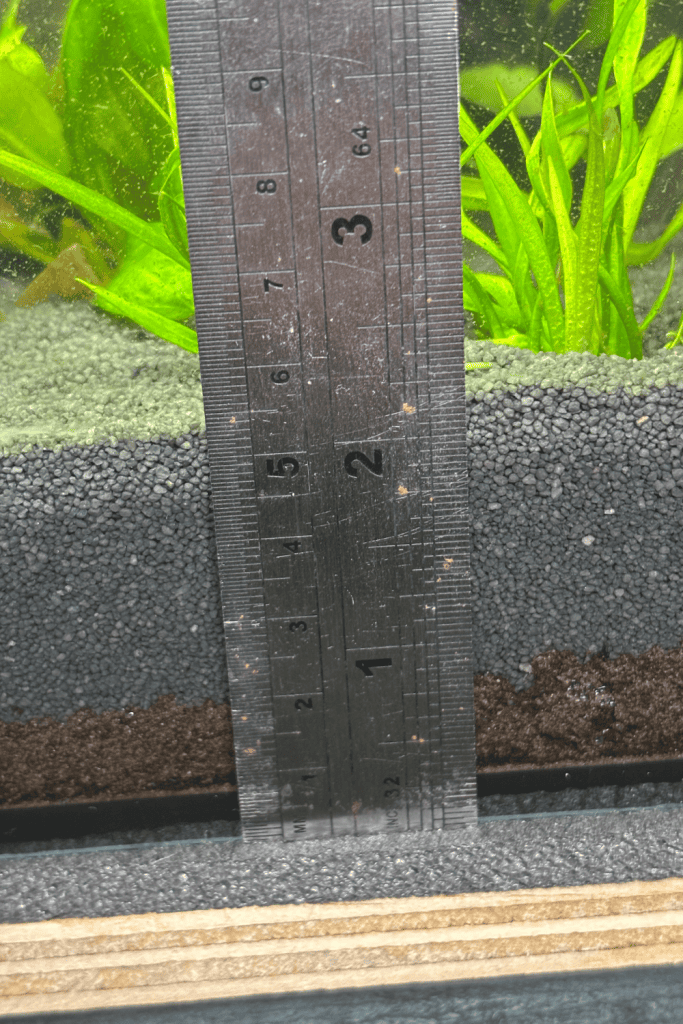
Capped dirt tanks are another great budget-friendly option.
This approach involves adding a thin layer (about 1–2.5 cm or ½–1 inch) of soil to the bottom of your tank, then capping it with an equal layer of sand or fine gravel.
While this method can produce fantastic results, it’s less beginner-friendly because there are more variables to control — from choosing the right soil type to managing the cap thickness and filling the tank carefully so the layers don’t mix.
If not done properly, you can end up with cloudy water or unstable parameters early on.
When set up correctly, though, capped dirt tanks are incredibly rewarding and can support lush plant growth with minimal fertilizer use.
Premium Sands And Gravels
On the higher end of the inert substrate category are premium products like Seachem Flourite or CaribSea Eco-Complete.
These are often marketed as having a high cation exchange capacity (CEC) — meaning they can absorb nutrients from the water column and make them available to plant roots1.
In theory, this sounds ideal, but there’s not much public data on their actual performance.
One independent test I came across reported Seachem Flourite with a CEC of 1.7, compared to less than 0.1 for regular play sand2.
For comparison, most clay-based aquasoils typically have a CEC between 30 and 100, depending on the mix and pH — a massive difference3.
While these premium gravels can look nice and work well, I personally find them a bit overpriced for what they offer.
Budget-Friendly Aquasoils

Finally, there are budget-friendly aquasoils like Fluval Stratum.
When I say “budget-friendly,” I mean compared to the ultra-premium brands like ADA — they’re still pricier than sand or gravel, but much easier for beginners to work with.
Aquasoils are clay-based and provide nutrients for your plants right from the start.
They also have high CEC, allowing them to “recharge” over time by absorbing nutrients from the water column, fish waste, or liquid fertilizers.
A few things to note if you’re using aquasoil:
- They lower pH temporarily by releasing hydrogen ions into the water. This buffering effect usually lasts a couple of months.
- They can release ammonia during the first few weeks after setup. This can harm livestock, so it’s important to do frequent water changes until levels stabilize.
My Recommendations
Personally, I find Fluval Stratum to be one of the easiest substrates for beginners.
You can use it straight out of the bag — no rinsing, no capping, and minimal mess.
Capped dirt is the more affordable option in the long run, but it requires more preparation and patience.
Natural Carbon Sources In Low-Tech Planted Tanks

One of the biggest misconceptions in the aquarium hobby is that you must use a CO₂ system to grow healthy, colorful plants.
That’s simply not true.
I’ve never used a CO₂ system on any of my tanks, and my plants continue to thrive.
In fact, I’ve written a full article about how to grow aquarium plants without CO₂, which you can find linked at the end of this post.
When set up correctly, it’s surprisingly easy to get great plant growth naturally — no pressurized CO₂ system required.
Where Natural CO₂ Comes From
It’s important to understand that CO₂ is already present in every aquarium.
It’s not something that only exists when you inject it.
Here’s where it comes from:
- Respiration — Fish, shrimp, snails, microorganisms, and even plants release CO₂ as they breathe.
- Decomposition — As fish waste, leftover food, and decaying plant matter break down, they release additional CO₂.
- Gas exchange — At the water’s surface, oxygen and CO₂ constantly balance between the tank and the air above.
Some setups with strong surface agitation can reduce CO₂ levels slightly, but there’s an interesting technique that actually turns this into an advantage.
Surface Agitation Can Increase CO₂ Levels
Dan’s Planted Tanks on TikTok shared a clever trick that uses water movement to help plants access more CO₂.
He runs a lot of surface agitation and water flow in his aquariums, which helps circulate dissolved CO₂ throughout the water.
This circulation allows plants to use CO₂ more efficiently, creating a small temporary shortage.
In response, the gas exchange at the surface pulls in more CO₂ from the air — effectively increasing overall CO₂ levels rather than reducing them.
So even in a tank with no injection system, there’s already plenty of CO₂ available for many aquatic plants — the key is choosing species that can thrive with it.
Best Plants For Natural CO₂ Environments
As mentioned earlier, easy-category plants like Anubias, Bucephalandra, and Cryptocoryne are perfect for low-tech tanks.
These species have evolved to live in environments with limited CO₂, at least for some of the year, and adapt well to natural conditions.
By contrast, many “medium” or “advanced” plants come from riparian habitats — places that are only occasionally underwater — and therefore rely on much higher CO₂ levels to stay healthy when fully submerged.
Bicarbonate Utilization — Another Hidden Carbon Source
Now, let’s touch on something a lot of aquarists overlook: bicarbonate utilization.
Some aquatic plants can absorb carbon not only from CO₂ but also from bicarbonates dissolved in the water.
Older research suggested this process wasn’t very effective underwater, but newer studies show that quite a few aquarium plants can use bicarbonates efficiently, depending on how their photosynthesis works.
C3 vs. C4 Pathways In Aquarium Plants
Aquatic plants use different photosynthetic systems to process carbon: C3, C4, or CAM45.
Since CAM plants don’t adapt well to submerged conditions, we’ll focus on the first two.
- C3 plants use an enzyme called RuBisCO, which is best for traditional CO₂ uptake but less efficient at using bicarbonate.
- C4 plants use PEPC, an enzyme that excels at utilizing bicarbonate-based carbon, making them thrive even in low-CO₂ environments.
In the aquarium hobby, there are two well-known C4 aquatic plants — Hydrilla verticillata and Egeria densa.
Both are famously easy to grow, partly because they can access this extra carbon source.
Interestingly, newer research shows that some C3 plants can partially switch to a C4-like process under certain conditions, which helps explain why so many species grow so well in low-tech tanks.
For example, Vallisneria can switch between these systems — even within the same leaf6.
The parts near the surface use the C3 pathway to absorb atmospheric CO₂, while the submerged parts use a C4-like process to pull carbon from bicarbonates in the water.
There’s also evidence suggesting that some Hygrophila and Cryptocoryne species can do the same789.
What This Means For Your Tank
The takeaway from all this science is simple: a large number of aquarium plants can grow beautifully using the natural CO₂ and bicarbonate already available in your tank.
Sure, adding pressurized CO₂ can give you faster growth and more compact plants, especially for stem species, but I would estimate that most easy-category plants can reach 80–90% of their full potential without it.
Fertilizing In Low-Tech Planted Tanks

Fertilization is another area where many beginners run into trouble.
It’s easy to assume that more nutrients will help your plants grow faster, but in a low-tech tank, that’s rarely true.
In fact, over-fertilizing is one of the quickest ways to trigger algae blooms, since excess nutrients tend to build up in the water where plants can’t use them fast enough.
The Fish Poop Fertilization Method
In all of my tanks, I rely on what I call the “fish poop fertilization method,” and it’s worked incredibly well.
Here’s how it works:
- You feed your fish high-quality food that’s rich in minerals and nutrients.
- Your fish naturally produce waste, which sinks into the substrate.
- Beneficial bacteria in your tank break down that waste, releasing nutrients back into the water column.
- Your plants then absorb those nutrients and use them for growth.
It’s a simple, natural cycle that mimics how nutrients are recycled in real aquatic ecosystems — and it costs nothing extra once your tank is running.
If you’re curious about what I use, my main foods are Fluval Bug Bites and the Hikari range for my fish, and GlassGarten Dandelion Pellets for my shrimp.
I also like to mix in a few treats once or twice a week for variety.
When You Might Need Extra Fertilizer
For most low-tech tanks, this natural system provides more than enough nutrients for healthy plant growth.
However, there are a couple of potential exceptions:
- Betta tanks, which often have a single fish and therefore very little waste.
- Shrimp-only tanks, which also have a low bioload.
In these cases, you may need to supplement with a liquid fertilizer, though even that’s not always necessary.
For example, my jungle-style betta tank runs entirely on the fish poop fertilization method — between the betta, shrimp, and snails, there’s enough waste cycling to keep the plants thriving.
Choosing And Dosing Liquid Fertilizers
If you do decide to add fertilizer, go for a “lite” or lean formula rather than a “complete” one.
These contain fewer nutrients, which reduces the risk of algae.
Start by dosing less than the manufacturer’s recommendation, since most instructions are written for high-tech tanks.
Aquascaper Josh Sim, the current IAPLC World Champion and one of the top names in the hobby, has mentioned that he doses around 50% of the recommended amount — and that’s in his high-tech, CO₂-injected tanks10.
If half doses of complete fertilizers work for him, you’ll need far less in a low-tech setup.
The Case For Potassium Supplements
While I don’t think most low-tech tanks need liquid fertilizers at all, there’s one possible exception — potassium.
Potassium deficiency is one of the most common nutrient issues in aquariums and can cause yellowing leaves or holes in plant tissue.
So, in some tanks, a potassium-based liquid fertilizer may be worth using.
Even so, you can often fix this naturally.
Feed your shrimp and snails high-potassium foods such as blanched spinach or dandelion leaf pellets.
When these foods are digested and broken down, the potassium in their waste becomes available to your plants — just like the fish poop fertilization method.
Keep It Simple
While many sources recommend root tabs or full liquid fertilizers, they’re not essential for a balanced low-tech tank.
By focusing on good feeding habits and healthy nutrient cycling, your plants can grow beautifully without the extra cost or algae risks that come with chemical fertilizers.
Temperature — The Most Important Factor In Plant Metabolism

One of the most overlooked aspects of maintaining a healthy planted aquarium is temperature.
It doesn’t get talked about nearly as much as lighting or fertilization, but it plays a huge role in how well your plants grow.
I recently watched a video on the Wired YouTube channel featuring Crime Pays But Botany Doesn’t, and he made an excellent point — plant metabolism is almost entirely dependent on temperature.
He’s absolutely right.
When water gets too cold or too warm, a plant’s internal processes slow down — or in extreme cases, stop altogether1112.
This means that even if you have perfect lighting, great fertilization, and balanced CO₂ levels, your plants still won’t thrive if the temperature isn’t within their comfort zone.
The Science Behind Temperature And Plant Growth
Research has shown that temperature directly affects enzyme activity inside plants.
If the water is too cold, enzymes slow down, and the plant may enter a dormant state — similar to how some terrestrial plants slow or even stop their growth in winter13.
On the other hand, if the water is too warm, metabolism speeds up too much, leading to stress and reduced efficiency in nutrient uptake14.
There’s also another factor to consider: CO₂ solubility.
Warm water holds less CO₂ than cooler water, which means that as your tank heats up, it releases — or “gasses off” — the limited natural CO₂ your plants depend on in a low-tech setup15.
This makes it even harder for them to grow properly.
Finding The Ideal Temperature Range
For most planted aquariums, the ideal temperature range is 22–28°C (72–82°F).
Staying within this range gives you the best balance between healthy plant metabolism, good nutrient absorption, and steady CO₂ levels.
Of course, some plants can tolerate — or even prefer — conditions outside that range.
For example, I keep a few room-temperature tanks that drop to around 18°C (64°F) during winter.
Many hardy species continue growing just fine at those lower temperatures.
I’ve written a separate article covering plants that handle cooler water well, which you can find linked at the end of this post.
The Bottom Line
Whether you’re running a low-tech or high-tech setup, temperature control is key.
You can have everything else perfectly balanced — your lighting, nutrients, and CO₂ — but if the temperature is off, your plants simply won’t perform at their best.
Aim to keep your tank within that 22–28°C (72–82°F) range for consistent, healthy growth all year round.
Water Flow In Low-Tech Planted Tanks

Water flow is often an underestimated part of a planted aquarium, especially in low-tech setups.
While it’s possible to maintain a thriving tank without any active flow, adding even a small filter, powerhead, or USB water pump can make a huge difference in your tank’s stability and overall health.
I keep several filterless tanks that rely entirely on plants to keep the water clean and safe for my fish.
Because these setups depend more on plants than on microorganisms for nutrient balance, it’s very easy to see how much of an impact water flow has from one tank to another.
Passive vs. Active Flow
In some tanks, I rely only on passive flow — the gentle water movement caused by temperature changes or by fish swimming around.
These tanks can work well, but they usually take far longer to stabilize.
By contrast, tanks that use USB water pumps or filters that create active flow tend to establish faster, maintain more stable water parameters, and have a lower risk of algae growth.
The difference becomes especially noticeable during the first few months of setup.
How Flow Helps Balance The Tank
To understand why water flow is so important, it helps to look at how nutrients and toxins work in a planted tank.
Many of the compounds that are potentially toxic to fish, shrimp, or snails are also nutrients that plants can absorb and use for growth.
That’s why aquarists often use the terms toxins and nutrients interchangeably when talking about planted aquariums.
Good water flow helps distribute these substances evenly throughout the tank, allowing plants to filter and absorb them more efficiently.
This not only keeps the environment healthier for your livestock but also prevents stagnant zones where waste and debris can accumulate.
The Role Of Hyperaccumulation
Many aquatic plants have evolved what’s known as hyperaccumulation abilities, meaning they can absorb and store certain potentially harmful elements — including heavy metals — in their tissues16.
These elements aren’t necessarily nutrients, but storing them makes the plants less appealing to herbivores, which helps them survive longer.
By improving circulation, you’re giving these plants better access to the compounds they can use to help stabilize the tank’s chemistry.
The Bottom Line
While you can run a low-tech tank without any active flow, it’s not ideal for beginners.
A small pump or gentle filter helps maintain consistent water quality, supports nutrient distribution, and reduces the risk of algae and stagnation.
If you’re setting up your first low-tech planted aquarium, adding even a tiny USB water pump is one of the easiest ways to improve your results and create a healthier, more balanced ecosystem for both your plants and your fish.
Final Thoughts

Setting up and maintaining a low-tech planted tank doesn’t have to be complicated or expensive.
By focusing on the fundamentals — the right plants, balanced lighting, a suitable substrate, natural carbon sources, and steady water flow — you can create a beautiful, thriving aquarium that’s easy to care for.
The key takeaway is that simplicity works.
You don’t need CO₂ injection systems, complex fertilizers, or premium equipment to grow healthy plants.
In most cases, nature already provides everything your aquarium needs — you just have to help it along by keeping things balanced.
Start with hardy, beginner-friendly plants like Anubias, Bucephalandra, and Cryptocoryne, pair them with reliable lighting like the Seaoura SR616, and use a simple substrate such as Fluval Stratum or inert sand.
Keep your temperature stable, add a bit of water flow, and let time do the rest.
Remember: planted tanks are living ecosystems.
The more you work with nature rather than against it, the more rewarding the hobby becomes.
With patience and consistency, you’ll be amazed at how vibrant and self-sustaining a low-tech planted tank can become.
Sources
- Cation Exchange Capacity and Base Saturation – https://fieldreport.caes.uga.edu/publications/C1040/cation-exchange-capacity-and-base-saturation/ ↩︎
- Substrate CEC lab analysis (Lab work on hold, now full discussion) – https://www.plantedtank.net/threads/substrate-cec-lab-analysis-lab-work-on-hold-now-full-discussion.1236673/ ↩︎
- Cation Exchange Capacity and Base Saturation – https://fieldreport.caes.uga.edu/publications/C1040/cation-exchange-capacity-and-base-saturation/ ↩︎
- Different photosynthetic inorganic carbon utilization strategies in the heteroblastic leaves of an aquatic plant Ottelia ovalifolia – https://www.frontiersin.org/journals/plant-science/articles/10.3389/fpls.2023.1142848/full ↩︎
- Kranz and single-cell forms of C4 plants in the subfamily Suaedoideae show kinetic C4 convergence for PEPC and Rubisco with divergent amino acid substitutions – https://academic.oup.com/jxb/article/66/22/7347/2893293 ↩︎
- Different mechanisms of bicarbonate use affect carbon isotope composition in Ottelia guayangensis and Vallisneria denseserrulata in a karst stream – https://www.sciencedirect.com/science/article/abs/pii/S0304377020301200 ↩︎
- Transition From Proto-Kranz-Type Photosynthesis to HCO3 Use Photosynthesis in the Amphibious Plant Hygrophila polysperma – https://www.researchgate.net/publication/352461118_Transition_From_Proto-Kranz-Type_Photosynthesis_to_HCO3_Use_Photosynthesis_in_the_Amphibious_Plant_Hygrophila_polysperma ↩︎
- A COMPARATIVE STUDY ON THE ACQUISITION OF INORGANIC CARBON BY FOUR NATIVE AQUATIC PLANTS FROM THE GENUS CRYPTOCORYNE AND AN AQUATIC WEED Hydrilla verticillata – https://www.mabjournal.com/index.php?Itemid=56&catid=59%3Acurrent-view&id=235&option=com_content&view=article ↩︎
- Cryptocoryne beckettii Thw. ex R. Trim. – https://nas.er.usgs.gov/taxgroup/plants/fact%20sheets/Cryptocoryne%20beckettii.pdf ↩︎
- Fertilization conspiracy nobody will tell you about – https://www.youtube.com/watch?v=-jfTQO0YsdM&t=545s ↩︎
- Plant tolerance to high temperature in a changing environment: scientific fundamentals and production of heat stress-tolerant crops – https://www.frontiersin.org/journals/plant-science/articles/10.3389/fpls.2013.00273/full ↩︎
- Rapid responses of plants to temperature changes – https://pmc.ncbi.nlm.nih.gov/articles/PMC5800372/ ↩︎
- Plant dormancy in the perennial context – https://www.sciencedirect.com/science/article/abs/pii/S1360138507000830 ↩︎
- Plant tolerance to high temperature in a changing environment: scientific fundamentals and production of heat stress-tolerant crops – https://www.frontiersin.org/journals/plant-science/articles/10.3389/fpls.2013.00273/full ↩︎
- Solubility of CO2 in water from -1.5 to 100°C and from 0.1 to 100 MPa: Evaluation of literature data and thermodynamic modelling – https://www.researchgate.net/publication/222567153_Solubility_of_CO2_in_water_from_-15_to_100C_and_from_01_to_100_MPa_Evaluation_of_literature_data_and_thermodynamic_modelling ↩︎
- Heavy metal hyperaccumulating plants: How and why do they do it? And what makes them so interesting? – https://www.sciencedirect.com/science/article/abs/pii/S0168945210002402? ↩︎