Honey Gourami
I’ve kept Honey Gouramis in several different setups over the years, and the tanks where they were most confident all had dense planting, floating cover, and quiet areas to retreat to.
This guide shows you how to recreate that environment, from tank size and filtration to feeding and tank mates.
Affiliate disclosure: I earn a commission when you buy through affiliate links on this page, at no extra cost to you.
At A Glance
| Care factor | Recommendation |
|---|---|
| Scientific name | Trichogaster chuna |
| Adult size | 5 cm / 2 inches |
| Minimum tank size | 40 litres / 10 US gallons |
| Water temperature | 22–28°C / 72-82°F |
| pH | 6.0–7.5 |
| GH | 4–12 dGH |
| Temperament | Peaceful |
| Diet | Omnivore |
| Lifespan | 2 – 4 years |
| Difficulty | Beginner-Friendly |
Honey gouramis are an excellent choice for a calm, well-planted aquarium, but they are not a fish I would add to a busy or sparsely decorated setup.
They are at their best when they have gentle tank mates, plenty of cover, and stable, warm water.
🟢 Buy If You Want…
- A peaceful, characterful centrepiece fish for a planted community aquarium.
- A fish that looks its best among dense planting, floating plants, and gentle tank mates.
- A smaller gourami that can work in a 40-litre (10 US gallon) aquarium when the setup and stocking are carefully planned.
- A species that is generally compatible with small rasboras, tetras, corydoras, and shrimp.
🟠 Look Elsewhere If You Want…
- A fish for a busy, high-flow aquarium with boisterous or nippy tank mates.
- A species that will thrive in a sparse tank without much plant cover.
Appearance & Size
Honey gouramis are small, laterally compressed labyrinth fish that normally reach around 5 cm / 2 inches in length.
Their modest adult size makes them far more suitable for smaller planted aquariums than many other gourami species, although they still need enough space and cover to feel secure.
Male vs Female Honey Gouramis
Male honey gouramis are usually more colourful, particularly once settled and in breeding condition.
They develop stronger yellow, orange, or red tones, often with a dark blue-black throat and belly.
Females are typically plainer, with softer silver, beige, or pale yellow colouring.
They are also usually rounder through the body, especially when carrying eggs, and may retain a more noticeable horizontal stripe.
Wild-Type Honey Gouramis

Wild-type honey gouramis tend to be subtler than the brightly coloured fish often sold in shops.
They are usually golden-brown or sandy in colour, with a darker horizontal stripe running along the body.
This natural colouration can be easy to overlook in a shop, but wild-type honey gouramis often look fantastic once settled into a heavily planted aquarium.
Sometimes Mislabelled As
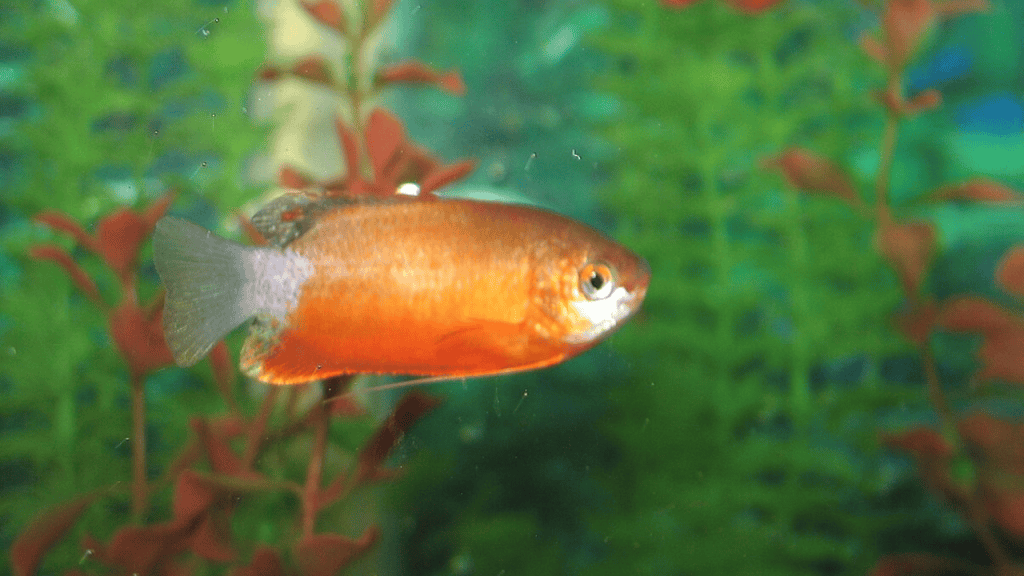
The Red Robin gourami, Red Honey gourami, and Paprika gourami are different trade names for the same fish, which is not a true honey gourami (Trichogaster chuna).
They are generally considered to be a selectively bred form of the thick-lipped gourami (Trichogaster labiosa), although their exact origins remain unclear.
They grow larger than true honey gouramis and can become considerably more territorial or aggressive as they mature, so I would not treat them as an interchangeable alternative.

The Gold gourami is also a different species: a gold colour morph of the three-spot gourami (Trichopodus trichopterus).
It can reach around 15 cm / 6 inches and may become aggressive, making it unsuitable for the smaller, peaceful community setup recommended for honey gouramis.
Natural Habitat


Wild honey gouramis (Trichogaster chuna) come from the slow-moving, heavily vegetated waters of India and Bangladesh.
They are found in shallow ponds, ditches, flooded fields, and quiet margins of rivers and streams, where the water is often warm, soft, and slightly acidic to neutral.
These habitats are usually packed with marginal plants, submerged vegetation, and floating cover.
The plants help break up lines of sight, provide shelter from predators, and create calmer pockets of water away from stronger currents.
This is why honey gouramis are at their best in a planted aquarium with a gentle flow and some surface cover.
A sparse, high-flow setup can leave them exposed and stressed, while floating plants and dense planting make them far more confident.
Aquarium Setup

Honey gouramis are at their best in a calm, heavily planted aquarium with plenty of cover around the middle and upper levels.
They can be shy when first introduced, so the aim should be to create a tank where they can explore without feeling exposed or having to compete with more boisterous fish.
Plants & Décor

Dense planting is one of the most important parts of a honey gourami setup.
Use a mixture of rooted plants, taller background plants, and floating plants to provide shade and cover near the surface.
Hardscape, such as smooth wood and branches, can help break up sightlines and create sheltered areas without taking away too much swimming space.
You can also add botanicals, such as dried leaves or seed pods, to make the aquarium feel more natural, although they are optional.
Choosing the Right Plants
| Plant | Surface Cover | Hiding Places | Filtration Support |
|---|---|---|---|
| Floating Plants | 🟢 | 🔴 | 🟢 |
| Anubias | 🔴 | 🟢 | 🔴 |
| Cryptocoryne | 🔴 | 🟡 | 🔴 |
| Echinodorus | 🟡 | 🟢 | 🟠 |
| Blyxa Japonica | 🔴 | 🟠 | 🟠 |
| Hygrophila | 🟡 | 🟡 | 🟢 |
| Hottonia Palustris | 🔴 | 🟡 | 🟠 |
| Heteranthera Zosterifolia | 🟡 | 🟡 | 🟢 |
| Aponogeton Ulvaceus | 🟡 | 🟢 | 🟢 |
| Ceratopteris Thalictroides | 🟢 | 🟡 | 🟢 |
| Nymphaea Lotus | 🟢 | 🔴 | 🟡 |
| Java Fern | 🔴 | 🟢 | 🟠 |
| Limnophila Sessiliflora | 🟡 | 🟡 | 🟢 |
| Ceratophyllum Demersum | 🟢 | 🟡 | 🟢 |
🟢 Excellent • 🟡 Good • 🟠 Acceptable • 🔴 Limited
There is no single best plant for a honey gourami aquarium.
Instead, aim for a mixture of plant types, including floating plants for surface cover, stem plants for dense background growth, rosette plants for lower-level shelter, and epiphytes or mosses around the hardscape.
Together, this creates a more natural setup with cover at every level of the aquarium while also supporting water quality.
Do Honey Gouramis Need Clear Access to the Surface?

Honey gouramis appreciate floating plants, as the shaded roots and surface cover help them feel secure.
However, they are labyrinth fish, so they still need clear gaps at the surface where they can come up and gulp atmospheric air.
I wouldn’t let floating plants completely cover the aquarium.
Leave several open areas around the surface, particularly near the front and wherever your honey gouramis naturally spend the most time.
Water Flow & Filtration
| Filter | Suitable Flow | Maintenance |
|---|---|---|
| Sponge Filter | 🟢 | 🟡 |
| Under Gravel Filter | 🟢 | 🟡 |
| Box Filter | 🟢 | 🟢 |
| Hang-On-Back | 🟡 | 🟢 |
| Plant-Based | – | 🟡 |
| Internal Filter | 🟡 | 🟢 |
| Canister Filter | 🟡 | 🟠 |
🟢 Excellent • 🟡 Good • 🟠 Acceptable • 🔴 Limited
Honey gouramis prefer gentle water movement, particularly around the surface where they spend much of their time.
Avoid directing a powerful filter outlet straight across the aquarium, as constant flow can make it difficult for them to rest comfortably and may leave them hiding.
A sponge filter or a suitably sized hang-on-back filter can both work very well, provided the flow is adjusted or diffused where needed.
The most important thing is maintaining stable water quality without turning the aquarium into a fast-flowing river.
Equipment I Recommend
| Equipment | Recommended | Good Alternative |
|---|---|---|
| Aquarium | 40 Litres (10 US Gallons) | 75 Litres (20 US Gallons) |
| Lighting | Budget Full-Spectrum | Full-Spectrum |
| Filter | Hang-On-Back | Sponge Filter |
| Heater | Adjustable Heater | Pre-Set Heater |
| Substrate | Inert Sand | Aquasoil |
| Food | Fluval Bug Bites | Hikari Micro Pellets |
| Hardscape | Rocks & Driftwood | Ceramic Décor |
| Water Conditioner | Tap Water Conditioner | Prime |
| Test Kit | Liquid Test Kit | Test Strips |
The recommendations above are based on what I would choose for a planted honey gourami aquarium, with alternatives included where there is more than one sensible option.
You can find more detailed product guides, reviews, and buying advice in my Aquarium Accessory Index.
Aquarium

Although I have seen some people keep a single honey gourami in a 20-litre / 5 US-gallon tank, I wouldn’t recommend it.
They are more of a bimbling species that likes to take its time exploring the aquarium, and mine have always shown more interesting behaviour when kept as a pair.
For this reason, I would recommend a 40-litre / 10 US-gallon aquarium as an absolute minimum, with a larger tank often being the better choice.
The table below covers my recommendations for popular aquarium sizes for honey gouramis.
| Tank Size | Recommendation |
|---|---|
| 20 Litres (5 US Gallons) | 🔴 |
| 40 Litres (10 US Gallons) | 🟠 |
| 54 Litres (14 US Gallons) | 🟡 |
| 75 Litres (20 US Gallons) | 🟢 |
| 110 Litres (29 US Gallons) | 🟢 |
| 150 litres (40 US gallons) | 🟢 |
🟢 Excellent • 🟡 Good • 🟠 Acceptable • 🔴 Limited
My tanks tend to have plenty of sight breaks and hiding places, so keeping two male honey gouramis together has not caused any major issues for me.
However, I have seen people with open aquariums, minimal planting, and few sight breaks report problems with competition between males.
The exact setup matters.
Something as simple as adding water lettuce can make a real difference, as its long roots create cover across a wide area near the surface and help block the line of sight between two bubble-nesting males.
Related Reviews
Lighting

One of the best things about honey gouramis is that many of the best plants for their aquarium are low-light friendly.
This means the stock lighting included with many entry-level aquarium kits can provide everything these plants need.
There are plenty of Anubias, Cryptocoryne, and Echinodorus varieties that grow perfectly well under these lights, helping to keep the overall cost of the setup as low as possible.
That said, an affordable full-spectrum LED can open up a wider range of easy-category plants, allowing you to do more with the aquarium.
Moving up a stage from there, an even more powerful aquarium light can open up options such as low-tech-friendly carpeting plants and red plants.
These are usually more for aesthetics, though.
Modern affordable lights are more than capable of growing the plants that offer the most practical benefits for honey gouramis, including hiding places, surface cover, and sight breaks.
Related Reviews
→ All Aquarium Light Reviews
→ The Best Low-Tech Aquarium Lights
Filter

There are plenty of filter options in the hobby that can work perfectly well for honey gouramis, giving you a lot of flexibility when choosing equipment.
While they tend to prefer gentler water movement, especially near the surface, most popular filter types can work well when the flow is suitable for the aquarium size.
My personal favourite is a hang-on-back filter, as it offers the right balance of performance, cost, and easy maintenance for my own tanks.
A sponge filter paired with a suitably sized air pump is also a good budget-friendly option that provides reliable biological filtration.
I have also kept two honey gouramis in a 150-litre / 40 US-gallon community aquarium with plenty of tank mates, running a Fluval FX2 canister filter, without any issues.
It is all about making sure the filter and its flow rate are suitable for the specific aquarium size and layout you are using.
Related Reviews
Heater

Although the suitable water-temperature range for honey gouramis is debatable, I prefer to keep mine within 22–28°C / 72–82°F.
This means most people will need a heater to maintain a suitable aquarium temperature, and I recommend the Fluval T-Series heaters.
I have used them in most of my tanks for years without any major issues, and they are widely available at a competitive price.
Related Reviews
→ All Aquarium Heater Reviews
→ Fluval T-Series Heater Review
Substrate

Substrate is another area where there is plenty of debate when it comes to keeping honey gouramis, but several options can work perfectly well.
If you are on a budget, inert sand can work very well, particularly when you use epiphyte plants attached to hardscape, which I cover in more detail later in the article.
My recent testing in planted tanks using inert sand also suggests that plenty of easy-category aquarium plants can grow in it without issue.
That said, aquasoil remains a popular choice.
It can help bring the pH down towards a more suitable range in areas with hard tap water, while also providing some peace of mind for planted-tank keepers.
This is because aquasoil can provide nutrients around plant roots, potentially improving growth depending on the exact plants and setup.
Related Reviews
Food

I have tried a wide range of foods with my honey gouramis over the years and, although they will eat plenty of different options, I think there are two clear winners.
All of my honey gouramis have absolutely loved Fluval Bug Bites and Hikari Micro Pellets, so I usually alternate between them daily to add variety to their diet.
One thing worth pointing out is that the breeders supplying the shops I buy from seem to raise their fry on granules and pellets rather than flakes.
If your fish have been raised on flakes, they may take a little time to get used to granules and pellets, but it shouldn’t take long.
Related Reviews
Hardscape
Unlike some species where hardscape can be considered optional, I think it is more important for honey gouramis, especially in community aquariums with other fish.
All of my honey gouramis have appreciated having hiding places and sight breaks, allowing them to get away from the activity in the tank when things become too much.
I have kept honey gouramis in four different aquariums over the years and have consistently seen them make full use of the cover available.
For example, when the harlequin rasboras and corydoras were breeding in one of those tanks, my honey gouramis spent more time around the hardscape and plants due to the increased activity.
As I touched on earlier, you can take your hardscape to the next level with epiphyte plants, such as Anubias, Bucephalandra, and Java fern.
These allow you to decorate rocks and driftwood with plants, adding colour and extra cover that your honey gouramis will appreciate.
Related Reviews
Water Conditioner

Always treat tap water with a suitable conditioner before adding it to a honey gourami aquarium, whether you are carrying out a water change or topping up water lost through evaporation.
Chlorine and chloramine in untreated tap water can harm honey gouramis and damage the beneficial microorganisms that keep the aquarium biologically filtered.
There is no need to buy an expensive all-in-one formula for routine water treatment.
I normally use API Tap Water Conditioner, which I have used across my aquariums for years without any issues.
Related Reviews
Test Kit

You can keep honey gouramis without owning a test kit, but I still think it is a worthwhile piece of equipment.
Honey gouramis can be shy by nature, so early signs of stress or water-quality problems can be easy to miss, especially for newer fish keepers.
A test kit lets you quickly check the water if their behaviour changes, they stop eating, or something in the aquarium seems wrong.
I prefer a liquid test kit. It costs more initially, but usually works out much cheaper per test over time.
Test strips are a good alternative if you want quicker, simpler testing. Just check which parameters they measure before buying, as most strips do not include ammonia.
Related Reviews
Water Parameters & Water Quality
| Parameter | Range | Priority |
|---|---|---|
| Temperature | 22–28°C / 72-82°F | 🟢 |
| Ammonia | 0 ppm | 🟢 |
| Nitrite | 0 ppm | 🟢 |
| Nitrate | <20 ppm | 🟡 |
| pH | 6.0–7.5 | 🟡 |
| GH | 4–12 dGH | 🟠 |
| KH | 0–8 dKH | 🟠 |
| TDS | 20–300 ppm | 🔴 |
🟢 High Priority • 🟡 Medium Priority • 🟠 Lower Priority • 🔴 Lowest Priority
Honey gouramis are fairly adaptable, but stable water conditions are far more important than trying to chase an exact number.
The table above shows the ranges I would aim for, with ammonia, nitrite, and temperature being the highest priorities.
The Nitrogen Cycle

Before adding honey gouramis, make sure the aquarium has completed the nitrogen cycle.
This is the process where beneficial microorganisms establish themselves in the filter, substrate, and across other surfaces in the aquarium.
These microorganisms process toxic ammonia from fish waste and uneaten food into nitrite, then into the much less harmful nitrate
Ammonia and nitrite should always remain at 0 ppm in a stocked honey gourami aquarium.
I usually use the dark start method when setting up a new aquarium.
It gives the biological filter time to establish before plants and fish are added, helping to make the early stages of a setup more manageable.
Once the aquarium is established, fast-growing plants can help absorb some nitrate and support water quality.
Temperature

Although honey gouramis can tolerate a reasonably broad temperature range, I prefer to keep mine between 22–28°C / 72–82°F.
For most people, this means using an aquarium heater, particularly through the colder months.
A stable temperature is more important than constantly adjusting the heater to chase the exact middle of the range.
Sudden swings can cause unnecessary stress, so choose a suitable heater for the aquarium size and check its performance with a separate thermometer.
pH & Water Hardness

Honey gouramis can adapt to a pH of around 6.0–7.5, along with a GH of 4–12 dGH and KH of 0–8 dKH.
While they naturally come from softer water, captive-bred honey gouramis can usually adapt well to a range of tap-water conditions.
I would not recommend making major changes to your water chemistry unless there is a clear reason to do so.
Stable water that sits slightly outside an ideal range is often safer than constantly adjusting pH, GH, or KH and creating instability.
If your tap water is especially hard and alkaline, aquasoil, botanicals, or reverse-osmosis water may be useful in some setups.
However, they should be used with a clear understanding of how they will affect the water, rather than as a quick fix.
Understanding Your Water Test Results

The chart above gives you a quick way to understand the most important results from a standard liquid test kit and when you may need to take action.
For all fish, ammonia and nitrite should always be 0 ppm.
Nitrate is less harmful, but I prefer to keep it below 20 ppm where possible through sensible stocking, feeding, water changes, and plenty of fast-growing plants.
Always consider the full set of results rather than focusing on one reading in isolation.
For example, a very low nitrate reading can be perfectly normal in a heavily planted, established aquarium, but it can also be a sign that a new aquarium has not completed its cycle yet.
Diet & Feeding

Honey gouramis are omnivores and will happily accept a wide range of prepared, frozen, and live foods.
The key is feeding suitably sized foods and providing enough variety to keep them in good condition, rather than relying on a single option every day.
You can find more suitable options in the commercial fish foods section of my Aquarium Accessory Index.
Staple Foods

My two preferred staple foods for honey gouramis are Fluval Bug Bites and Hikari Micro Pellets.
All of the honey gouramis I have kept have eaten both enthusiastically, so I normally alternate between them daily.
Feed a small amount once or twice a day, only giving them what they can eat within a couple of minutes.
Honey gouramis are slow, deliberate feeders, so make sure quicker tank mates are not taking most of the food before they get a chance to eat.
Treat Foods

Frozen and live foods are a great way to add variety to your honey gouramis’ diet.
Suitable options include daphnia, copepods, cyclops, and mini bloodworms.
These should be treats rather than the main diet.
Feeding them once or twice a week alongside a good-quality staple food gives honey gouramis a more varied diet without encouraging overfeeding.
| Day | Food |
|---|---|
| Monday | Fluval Bug Bites |
| Tuesday | Hikari Micro Pellets |
| Wednesday | Fluval Bug Bites |
| Thursday | Hikari Micro Pellets |
| Friday | Fluval Bug Bites |
| Saturday | Hikari Micro Pellets |
| Sunday | Treat Food |
Botanicals & Natural Foraging

Adding leaves, seed pods, and other botanicals can help create a more natural environment for honey gouramis.
As they break down, they support biofilm and microorganisms that fish and other aquarium livestock may browse on.
Botanicals are not a replacement for feeding your honey gouramis in most setups, but they can add another layer of natural foraging to a mature planted aquarium.
They also work particularly well alongside dense planting and floating plants, helping the tank feel more secure.
Behaviour & Temperament

Honey gouramis are usually peaceful, gentle fish, but they can be shy in a busy community aquarium.
Their behaviour can vary depending on the individual fish, tank size, planting, and the species kept alongside them.
With Community Fish
I have never seen my honey gouramis interact aggressively with any of their tank mates.
Rather than becoming pushy or territorial, as some sources suggest, mine tend to move into the plants or hardscape if there is too much commotion in the aquarium.
This is one reason why I recommend plenty of dense planting, floating plants, and hardscape.
It gives them somewhere to retreat to when faster or more active community fish are moving around the tank.
With Other Honey Gouramis
Male honey gouramis may chase and spar with one another, particularly when there are not enough hiding places or sight breaks.
In my experience, they rarely make physical contact, but this will depend heavily on the aquarium layout and how much cover is available.
Males may also follow females around the aquarium when they are looking to breed.
This is normal behaviour, but a well-planted tank gives the female space to move away when she is not interested.
Stocking Guidelines
| Tank Size | Recommendation |
|---|---|
| 20 Litres (5 US Gallons) | 🔴 |
| 40 Litres (10 US Gallons) | 🟠 |
| 54 Litres (14 US Gallons) | 🟡 |
| 75 Litres (20 US Gallons) | 🟢 |
| 110 Litres (29 US Gallons) | 🟢 |
| 150 litres (40 US gallons) | 🟢 |
🟢 Excellent • 🟡 Good • 🟠 Acceptable • 🔴 Limited
A 40-litre / 10 US-gallon aquarium is the absolute minimum I would consider for honey gouramis, but it needs to be heavily planted, sensibly stocked, and carefully maintained.
I wouldn’t recommend keeping them in a 20-litre / 5 US-gallon aquarium, even if it is only for a single fish.
A 54-litre / 14 US-gallon aquarium gives you more room to create separate areas with plants and hardscape, making it a more forgiving option.
Once you reach 75 litres / 20 US gallons or above, you have far more flexibility to keep a pair or small group alongside suitable peaceful community fish.
Can You Keep a Single Honey Gourami Alone?
Honey gouramis are not shoaling fish, so a single fish will not become lonely in the same way that a tetra or rasbora might.
A lone honey gourami can live in a suitably sized, well-planted aquarium.
That said, I have found that my honey gouramis show more interesting behaviour when kept with other honey gouramis.
I would therefore choose a compatible pair or group where the tank size, planting, and number of hiding places make that practical.
Stocking Honey Gouramis in Community Aquariums

Honey gourami stocking is not just about litres or gallons.
The aquarium layout, number of fish, planting density, sight breaks, and activity level of their tank mates all matter just as much.
Larger aquariums, such as 110 litres / 29 US gallons and 150 litres / 40 US gallons, are excellent for a planted community setup.
The extra space makes it easier to provide cover, reduce competition, and give honey gouramis somewhere to retreat when other fish become more active.
Tank Mates
| Species | Compatibility | Parameters |
|---|---|---|
| Bettas | 🟠 | 🟢 |
| Guppies | 🟠 | 🟠 |
| Neon Tetra | 🟢 | 🟢 |
| Cardinal Tetra | 🟢 | 🟢 |
| Corydoras Aeneus | 🟢 | 🟢 |
| Harlequin Rasbora | 🟢 | 🟢 |
| Zebra Danio | 🟢 | 🟡 |
| Siamese Algae Eater | 🟢 | 🟢 |
| Lambchop Rasbora | 🟢 | 🟢 |
| Chili Rasbora | 🟢 | 🟢 |
| Clithon Snail | 🟢 | 🟢 |
| Nerite Snail | 🟢 | 🟢 |
| Amano Shrimp | 🟢 | 🟢 |
| Neocaridina Shrimp | 🟢 | 🟢 |
🟢 Excellent • 🟡 Good • 🟠 Caution • 🔴 Avoid
Honey gouramis are peaceful community fish, but the best tank mates are calm species that will not constantly compete with them for food or make them feel exposed.
The table above shows how I would rate some of the most popular options based on both compatibility and water-parameter overlap.
Betta Fish

Some betta fish can work in peaceful community aquariums, but every betta has its own personality and some can be aggressive.
Because of that unpredictability, I wouldn’t recommend keeping bettas with honey gouramis.
Guppies

Guppies are one of the most popular fish in the hobby, but their ideal water parameters are slightly different from those of honey gouramis.
Guppies usually prefer harder, more alkaline water, while honey gouramis are generally better suited to softer, slightly acidic to neutral water.
Community Fish

I have kept honey gouramis with a wide range of popular community species, including rasboras, tetras, corydoras, zebra danios, and Siamese algae eaters, without ever having an issue.
In my experience, honey gouramis are more likely to move into cover when a tank becomes too active than to become aggressive themselves.
Dense planting, floating plants, and sight breaks are still important, particularly in busy community aquariums.
Community Fish Care Guides
Shrimp
Some sources suggest that honey gouramis may hunt shrimp, but I have never seen this with mine.
I have lost count of the number of times I have watched my honey gouramis swim past tiny Neocaridina shrimplets without paying them any attention.
That said, I still would not treat any fish as completely shrimplet-safe.
Dense planting, moss, leaf litter, and other cover will always give baby shrimp the best chance of surviving.
Shrimp Care Guides
→ All Shrimp Care Guides
→ Cherry Shrimp (Neocaridina) Care Guide
→ Amano Shrimp Care Guide
Snails

I have kept honey gouramis with several snail species, including nerite and Clithon snails, without ever seeing them try to eat or bother them.
Snails are one of the safest and easiest tank-mate options for a honey gourami aquarium.
Snail Care Guides
→ All Aquatic Snail Care Guides
→ Zebra Nerite Snail Care Guide
→ Clithon Snail Care Guide
Health & Common Problems

Honey gouramis are generally hardy fish once they are settled into a mature, stable aquarium.
Most health problems come back to poor water quality, stress from unsuitable tank mates, or introducing new fish without a sensible quarantine period.
Signs of a Healthy Honey Gourami
A healthy honey gourami should be alert, eat enthusiastically, and regularly explore the aquarium.
They may spend time resting among plants or around hardscape, particularly in a busy community tank, but they should not constantly hide, clamp their fins, or struggle to breathe.
Poor Water Quality
Ammonia and nitrite are the biggest immediate water-quality risks. Both should always be at 0 ppm, as even low readings can irritate the gills and cause stress.
Watch for rapid breathing, hanging near the surface, clamped fins, loss of appetite, or unusual lethargy.
These symptoms can have several causes, but testing the water should always be one of the first steps.
Stress From Tank Mates
Honey gouramis can become stressed in aquariums with aggressive, overly active, or fin-nipping tank mates.
Mine tend to retreat into planting and hardscape when there is too much activity, which is why dense cover and sight breaks are so important.
Long-term stress can make fish more vulnerable to other health problems, so do not ignore a honey gourami that is constantly hiding or being chased.
Common Fish Diseases
Like most community fish, honey gouramis can catch common diseases such as white spot, fungal infections, bacterial infections, and external parasites.
Look out for white spots, frayed fins, unusual patches on the body, flashing against objects, or a sudden change in behaviour.
If you notice a problem, check the water parameters first and avoid adding medication without a clear reason.
The wrong treatment can create more stress and may harm beneficial microorganisms in the aquarium.
Protecting Their Labyrinth Organ
Honey gouramis have a labyrinth organ that allows them to breathe atmospheric air from the surface.
Keep the aquarium covered where possible, particularly during colder months, so the air above the water stays warm and humid.
Repeatedly breathing cold air can irritate this sensitive organ, while ammonia, nitrite, and untreated tap water can damage the gills that honey gouramis also rely on.
Final Thoughts

Honey gouramis are one of my favourite freshwater fish, and I think they are an excellent choice for a calm, well-planted aquarium.
They have plenty of personality, look fantastic once settled, and can work with a wide range of peaceful community species.
The key is giving them a mature aquarium with stable water, gentle flow, plenty of plants, and enough sight breaks to feel secure.
Get those basics right and, in my experience, honey gouramis are rewarding fish that you can enjoy for years.
Image Rights
Chalan Beel Jubair Bin Iqbal, CC BY-SA 4.0, via Wikimedia Commons
Honey gourami red variant by Eevay
A Wild Honey Gourami Image Rights /r/keeper25
Sources
- GBIF Species Information: Trichogaster chuna ↩︎
- Bangladesh Species Database: Chuna Khalisha ↩︎
- PubMed: Evaluation of Growth Performance in Honey Gourami ↩︎
- Wikipedia: Trichogaster ↩︎
- UKAPS Forum: Discussion on Honey Gourami and Red Honey Gourami ↩︎
- Tropco: Honey Gourami Profile ↩︎
- Fishlore Forum: Can Different Species of Gouramis Hybridize? ↩︎
- Reddit Discussion: Golden Gourami vs. Golden Honey Gourami ↩︎
- ResearchGate: Seasonal Variation in Water Quality – Kuwano River ↩︎
- ResearchGate: Protein and Lipid Requirements for Honey Gourami ↩︎